
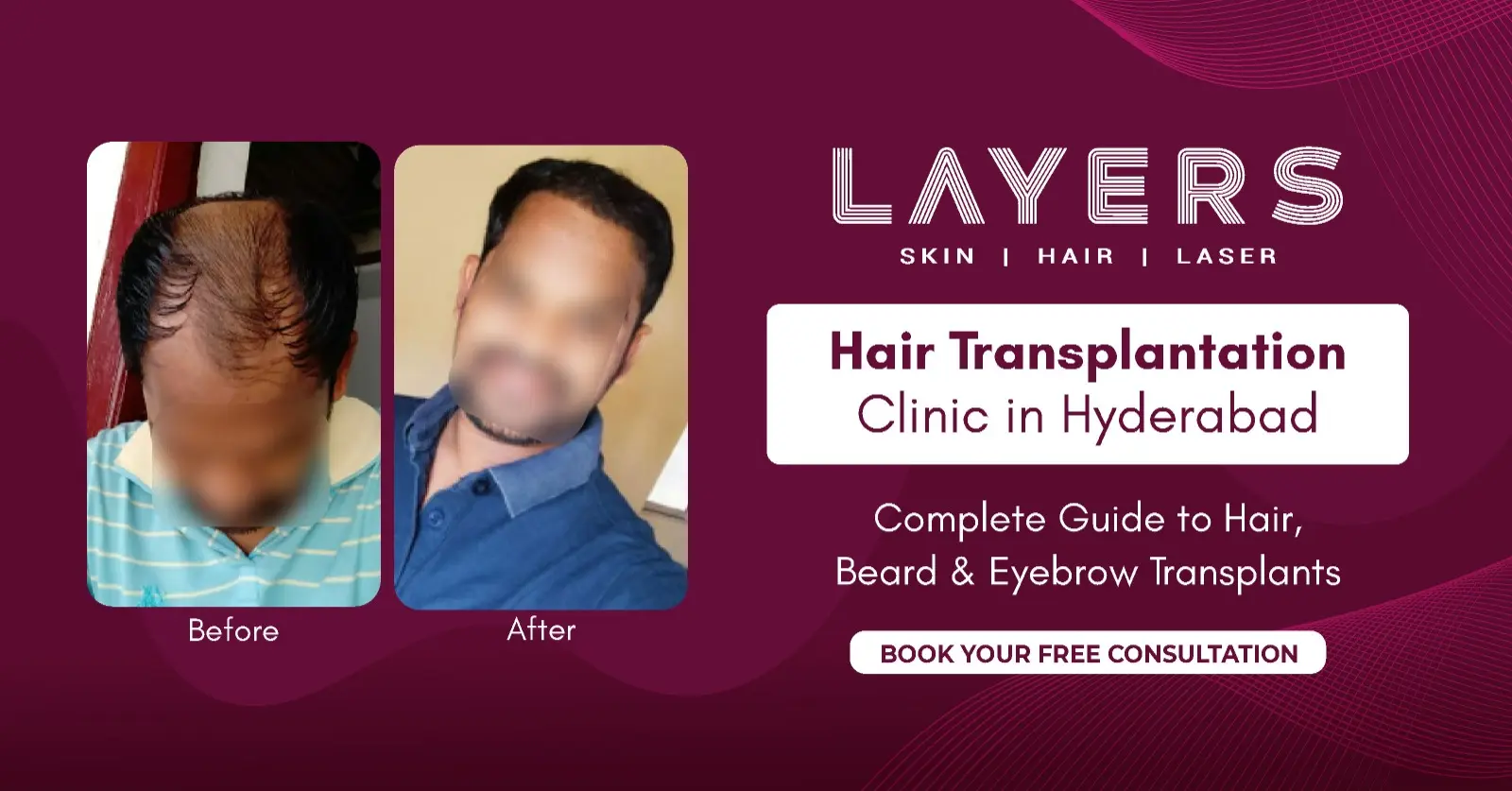
Choosing the right Hair Transplantation Clinic in Hyderabad is no longer just about fixing a receding hairline. Modern hair restoration now covers the scalp, beard, eyebrows, mustache, sideburns, and even scars using techniques that are more precise and natural-looking than ever before.
At Layers Clinics, we get asked one question more than any other: “Which option is actually right for me?“ This guide answers that. Rather than repeating the technical details of FUE and FUT already covered on our hair transplant service page, we’re going a level deeper into candidacy, technique selection, hairline design, and the restoration options patients in Hyderabad often don’t know exist.
By the end of this guide, you’ll know:
- Which parts of the body can be restored beyond the scalp
- How to tell if you’re a good candidate
- How surgeons decide between techniques for your specific case
- Why hairline design matters more than graft count
- What myths are quietly stopping people from getting treated
What Areas Can Be Treated with Hair Transplantation?
When most people search for a hair transplant doctor in Hyderabad, they assume the conversation starts and ends with the scalp. In reality, the same follicular unit techniques used for the head are now routinely applied to:
- Scalp hair — crown thinning, receding hairlines, diffuse thinning
- Beard hair — patchy, thin, or uneven beard growth
- Eyebrow hair — sparse or over-plucked eyebrows
- Mustache hair — missing or asymmetrical mustache growth
- Sideburns — reconstruction after previous surgery or genetic thinning
- Scar areas — hair regrowth over surgical, accident, or burn scars
- Female hairlines — restoration for postpartum or traction-related hair loss
This range matters because a single donor area usually the back of the scalp can often supply grafts for more than one of these goals in the same treatment plan. A clinic that only talks about scalp restoration is only showing you part of the picture.
Signs You Should Visit a Hair Transplantation Clinic
Not every case of thinning hair needs surgery, and not every case should wait. These are the signals worth a professional consultation rather than a wait-and-watch approach:
- A receding hairline that has moved noticeably in the last 12 months
- Crown thinning visible under indoor lighting or in photographs
- Visible scalp through the hair when parted
- A patchy or uneven beard that doesn’t respond to grooming
- Eyebrows thinned by over-plucking, age, or genetics
- Hair loss following a burn, injury, or surgical scar
- A previous transplant that didn’t deliver the expected density or natural look
If any of these sound familiar, the right next step is a scalp and donor-area assessment not a guess based on what worked for someone else.
Which Hair Restoration Option Fits Your Situation?
Every restoration goal has a different “right answer” depending on the area, the density needed, and the donor hair available. Here’s a quick-reference view:
| Concern | Best-Suited Approach |
| Small, localized bald patch | Precision extraction technique |
| Maximum density over a larger area | Strip-based harvesting technique |
| Natural, undetectable hairline | Direct implantation technique |
| Beard restoration | Direct implantation or precision extraction |
| Eyebrow restoration | Direct implantation (single-hair precision) |
| Scar coverage | Precision extraction technique |
The right choice isn’t about which technique sounds most advanced it’s about which one matches your donor supply, the area being treated, and how much precision the result demands. This is exactly why the consultation and donor assessment matter more than the marketing name of any single procedure.
Consolidated Guide: Beard, Eyebrow, Mustache, Sideburn & Scar Restoration
Beard Transplant
Used for patchy beard growth, thin coverage along the jawline, or uneven density across the cheeks and chin. Grafts are placed at an angle that matches natural beard hair direction, which is what separates a natural-looking result from an obviously “added” patch of hair.
Eyebrow Transplant
A precision procedure eyebrow hair is finer and grows at a shallower angle than scalp hair, so single-hair placement is essential. Common candidates include people dealing with over-plucking damage, genetically sparse eyebrows, or eyebrow loss following an injury.
Mustache Transplant
Addresses missing sections, uneven growth patterns, or scar-related gaps in the mustache. Because the treatment area is small, artistry in graft placement matters as much as the technique itself.
Sideburn Restoration
An often-overlooked option useful for reconstructing sideburns after a previous transplant altered the hairline, or for genetic thinning in that specific zone.
Scar Hair Transplant
Hair can often be regrown directly over scar tissue from past surgery, burns, or accidents, provided there’s enough blood supply in the area. This is one of the more specialized applications of modern transplant technique and works best when planned early.
Hairline Design: The Detail Most Clinics Skip
Graft count gets all the attention, but hairline design is what actually determines whether a result looks natural or “done.” A well-planned hairline accounts for:
- Face shape — the hairline should frame the face, not just fill it in
- Age — a hairline placed too low or too straight often looks unnatural on older patients
- Existing hair pattern — new grafts need to blend with what’s already there
- Hair growth direction — angle and direction affect how light and shadow fall on the scalp
- Density distribution — denser at the front, gradually softer toward the crown
- Temple point design — often the single biggest giveaway of a poorly planned transplant
This is design work as much as it is medical work, which is why the surgeon’s eye for aesthetics matters just as much as their technical skill.
Eyebrow Transplant vs. Microblading: Which Lasts Longer?
Patients frequently compare permanent eyebrow restoration with microblading, a cosmetic tattooing technique. Here’s how they differ:
| Factor | Eyebrow Transplant | Microblading |
| Result type | Real, growing hair | Pigment deposited in skin |
| Longevity | Permanent | Fades in 1–3 years, needs touch-ups |
| Maintenance | Occasional trimming | Regular re-touching sessions |
| Texture | Natural hair growth and movement | Flat, drawn appearance |
| Best for | Long-term, natural restoration | Short-term cosmetic enhancement |
Neither option is universally “better” it depends on whether you want a permanent, natural-growing result or a lower-commitment cosmetic fix.
Common Myths About Hair Transplant — Debunked
- “It’s extremely painful.” Modern procedures are performed under local anesthesia; most patients describe mild discomfort, not pain.
- “The results always look fake.” Unnatural results are almost always a hairline-design or graft-angle issue, not a limitation of the technique itself.
- “Women can’t get a hair transplant.” Female pattern hair loss, traction alopecia, and postpartum thinning are all treatable with the same techniques.
- “It fails most of the time.” Failure rates are low when performed by an experienced surgical team with proper donor assessment.
- “Hair grows back immediately.” Growth is gradual, shedding of transplanted hair in the first weeks is normal, with visible growth over several months.
- “One technique suits everyone.” As shown in the comparison table above, the right approach depends entirely on the individual case.
Female Hair Transplantation Clinic in Hyderabad: A Growing Need
Female hair loss is increasingly common and increasingly treatable. The most frequent cases we see include:
- Hairline lowering for naturally high or receding hairlines
- Traction alopecia from tight hairstyles worn over years
- Postpartum hair loss that doesn’t fully reverse on its own
- Female pattern baldness with diffuse thinning across the scalp
- Overall density loss affecting scalp coverage and part-line visibility
Because female hair loss patterns differ from male pattern baldness, treatment planning requires a different approach to donor extraction and graft placement which is why a dedicated consultation matters more than a generic “one-size” plan.
Who Isn’t an Ideal Candidate?
Hair transplantation isn’t right for every situation. A qualified surgeon should flag these before recommending surgery:
- Active scalp infection or inflammation
- Insufficient donor hair to support the desired coverage
- Uncontrolled diabetes or other unmanaged medical conditions
- Certain autoimmune conditions affecting hair follicles
- Temporary or stress-related shedding that may resolve without surgery
A responsible clinic will tell you when not to proceed that’s as important as knowing when to.
Why Patients Choose Layers Clinics
Beyond the procedures themselves, what shapes the outcome is the team and process behind them:
- Experienced surgeons with dedicated focus on hair, beard, and eyebrow restoration
- Thorough donor and scalp diagnostics before any treatment plan is finalized
- Hairline and density planning tailored to face shape and age
- Modern graft-handling protocols to protect follicle survival
- A dedicated, sterile transplant environment
- Personalized post-procedure follow-up
- A strong track record of patient satisfaction across Hyderabad
Frequently Asked Questions
Can women get an eyebrow transplant?
Yes, eyebrow transplants are one of the most common restoration procedures we perform for women. They work especially well for over-plucked, thinning, or genetically sparse eyebrows, giving a natural, permanent result.
Will transplanted hair fall out again?
Transplanted follicles are typically resistant to the hormonal triggers that cause pattern baldness, so long-term shedding of those grafts is uncommon.
How soon can I travel after the procedure?
Most patients can travel within a few days, depending on the extent of the procedure and how the scalp is healing. Your surgeon will confirm the right timeline based on your individual recovery.
Can I wear a helmet after surgery?
This should wait until your surgeon confirms the scalp has healed enough to tolerate pressure and friction. Wearing one too early can disturb newly placed grafts and affect the final result.
Can I color my hair after a transplant?
Yes, hair coloring is generally fine once healing is complete. Timing varies from person to person, so it’s best to confirm the right window with your surgeon before your next salon visit.
Conclusion
Hair restoration today goes far beyond a single technique or a single treatment area. Whether it’s a receding hairline, a patchy beard, thinning eyebrows, or scar-related hair loss, the right outcome depends on accurate diagnosis, thoughtful hairline design, and a technique matched to your specific case not a one-size-fits-all approach.
If you’re exploring options as a patient in Hyderabad, the most reliable next step is a proper consultation and donor assessment with a team that treats every area, not just the scalp.
Ready to find out which restoration option is right for you? Book a consultation with the specialists at Layers Clinics trusted Hair Transplantation Clinic in Hyderabad.
