
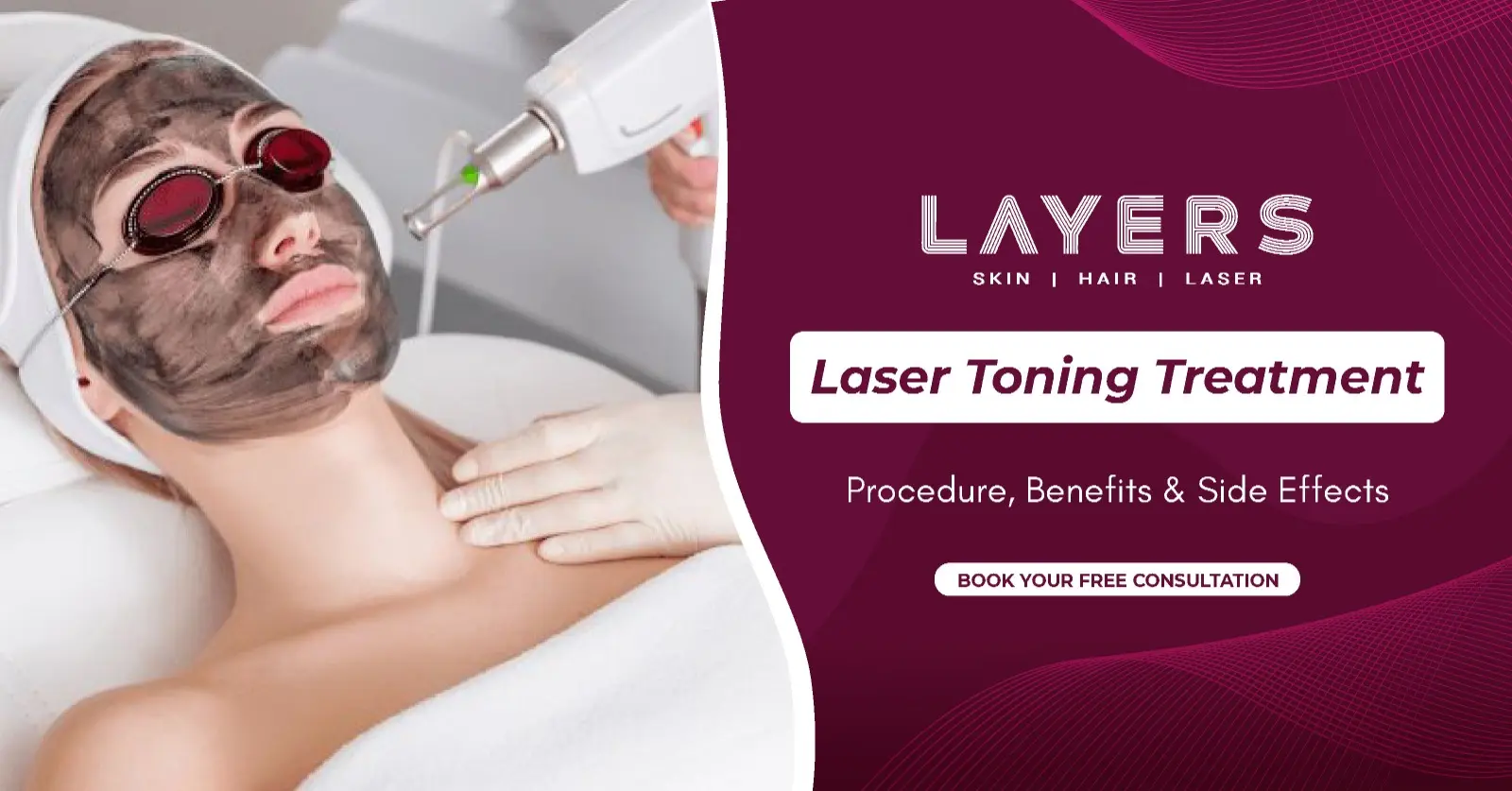
What starts as a mild tan or a few post-acne dark marks can quietly turn into patches that refuse to fade no matter how many “brightening” serums you try. When topical treatments hit a plateau, laser toning treatment is often the next step dermatologists recommend, and it’s become one of the most requested procedures for pigmentation and dull skin among Indian skin types specifically.
This guide covers exactly how laser toning works, what concerns it treats, how it compares to peels and other lasers, what it costs, and what you need to know before booking your first session.
What Is Laser Toning and How Does It Work?
Laser toning is a non-invasive dermatological procedure designed to break down excess pigment and restore skin clarity. Unlike aggressive resurfacing lasers that strip away the top layer of skin, laser toning works from the inside out, targeting pigment in the deeper dermal layers without disturbing the skin’s surface.
At Layers Clinics, we use the Q-switched Nd:YAG laser, a technology particularly well-regarded by dermatologists because it’s exceptionally safe for pigmented skin a key consideration, since darker skin types are more prone to post-treatment pigmentation issues with less carefully chosen lasers.
How Does the Process Work?
The effectiveness of laser toning comes down to precision. The device delivers controlled, low-intensity pulses of light into the deeper skin layers:
- Pigment breakdown — light pulses are absorbed by melanin, shattering it into microscopic particles
- Natural elimination — the body’s immune system gradually flushes these particles away over the following weeks
- Collagen stimulation — the gentle heat generated triggers fibroblasts to produce new collagen, which refines pores and softens fine lines alongside clearing pigment
This dual action pigment clearance plus a mild collagen response is why laser toning is often described as a glow treatment as much as a pigmentation treatment.
What Skin Concerns Can Laser Toning Treat?
- Melasma — including hormonal patches often called the “mask of pregnancy”
- Sun damage — sunspots and chronic tanning from prolonged sun exposure
- Post-acne marks — lingering brown and red spots left behind after breakouts
- Textural issues — enlarged pores and early fine lines
- Dullness — an overall tired, uneven complexion
What Are the Benefits of Laser Toning Treatment?
- No social downtime — sessions can fit into a lunch break, with no major peeling or visible redness afterward
- Minimal discomfort — most patients describe the sensation as a light snapping feeling or mild warmth, not pain
- Low risk of scarring — as a non-ablative laser, it doesn’t break the skin’s surface, keeping the risk of scarring or rebound pigmentation very low
- Natural-looking results — improvement is gradual, so skin looks like a healthier, brighter version of itself rather than visibly “treated”
What Happens During a Laser Toning Session?
A typical session lasts 30–45 minutes. After thorough cleansing and the application of protective eyewear, your dermatologist passes the laser handpiece over the target areas in controlled passes.
Post-treatment, a cooling, soothing cream and a high-SPF sunscreen are applied. You may notice a slight pinkish glow for an hour or two, but it settles quickly, leaving skin feeling refreshed rather than irritated.
How Many Laser Toning Sessions Do You Need?
Laser toning is a gradual process, not a one-session fix:
- Number of sessions: most people see optimal results after 6–8 sessions
- Frequency: sessions are typically spaced 2–4 weeks apart
- Longevity: the laser clears existing pigment, but it can’t prevent new pigment from forming if hormonal triggers or sun exposure aren’t managed. Maintenance sessions every few months help sustain results long term
Laser Toning vs Chemical Peel vs IPL vs Fractional Laser
| Feature | Laser Toning | Chemical Peels | IPL Photofacial | Fractional CO2 Laser |
|---|---|---|---|---|
| Primary goal | Pigmentation & glow | Surface exfoliation | Redness & broad pigmentation | Deep scarring/wrinkles |
| Downtime | None | 3–7 days (peeling) | 1–2 days (mild redness) | 7–10 days (scabbing) |
| Pain level | Very low | Stinging/burning | Low to moderate | Moderate (requires numbing) |
| Skin safety | High for all types | Varies by acid strength | Higher risk for dark skin | High risk for dark skin |
| Best for Indian skin tones | Yes | Yes, with the right acid | Use with caution | Requires expert handling |
For pigmented Indian skin specifically, laser toning and well-formulated chemical peels are generally the safer starting points IPL and fractional CO2 carry a higher risk of post-inflammatory pigmentation if not handled by an experienced dermatologist.
Who Should Avoid Laser Toning?
Laser toning has a strong safety profile, but it’s not automatically right for everyone. A dermatologist consultation is recommended first if you:
- Are currently on isotretinoin or have used it within the last 6 months
- Have an active skin infection, open wound, or recent sunburn in the treatment area
- Are pregnant or breastfeeding
- Have a history of keloid scarring or unusually reactive skin
- Have very recently tanned or plan significant sun exposure shortly after treatment
What Are the Side Effects of Laser Toning?
Laser toning is considered low-risk, but it’s not entirely without side effects. Most people experience only a temporary pinkish flush that fades within a couple of hours. Less commonly, some people notice mild itching or dryness for a day or two.
Rebound pigmentation or temporary lightening of the treated area can occur if sunscreen and aftercare aren’t followed consistently which is why post-treatment sun protection isn’t optional, it’s the single biggest factor in how well results hold.
Laser Toning Aftercare: What Should You Do?
Before your session:
- Avoid direct sun exposure for at least a week
- Stop using harsh actives like retinol or glycolic acid 3 days prior
- Keep skin well hydrated in the days leading up to treatment
After your session:
- Sunscreen is non-negotiable — apply a broad-spectrum SPF 30+ daily, even indoors
- Moisturize with a gentle, fragrance-free formula to support the skin barrier
- Skip the gym — avoid heavy sweating or saunas for 24 hours to prevent irritation
- Be patient — while a glow appears after one session, the best results build over 4–6 sessions
Is At-Home Laser Toning Safe?
Handheld “IPL” or laser devices marketed for home use are not the same technology as clinic-grade Q-switched Nd:YAG lasers, and they don’t offer the same calibrated control over depth and intensity. For pigmented skin especially, using an underpowered or poorly calibrated device carries a real risk of uneven results or triggering further pigmentation. Laser toning is best performed by a trained dermatologist who can assess your skin type and adjust settings session to session.
How Much Does Laser Toning Cost in India?
Pricing depends on the city, clinic quality, technology used, and the size of the area being treated:
| Treatment Scope | Typical Price Range (per session) |
|---|---|
| Small area (spot treatment) | ₹1,500 – ₹2,500 |
| Full face | ₹2,500 – ₹4,000 |
| Package of 6–8 sessions | Often discounted per session vs. single bookings |
Layers Clinics uses FDA-approved laser technology, and since laser toning is delivered as a multi-session course, most clinics including ours offer package pricing that works out more cost-effective than paying per session individually. A consultation is the most reliable way to get an accurate quote based on your skin condition and the number of sessions your case is likely to need.
Why Choose Layers Clinics for Laser Toning?
- FDA-approved Q-switched Nd:YAG laser technology suited to Indian skin types
- Experienced dermatologists who calibrate treatment settings to your specific skin tone and pigmentation type
- Transparent session planning and package pricing, with no guesswork on total cost
- A structured aftercare protocol to protect results between sessions
Frequently Asked Questions
What is laser toning treatment used for?
Laser toning treats pigmentation concerns like melasma, sun spots, and post-acne marks, while also improving overall skin texture, pore size, and dullness through mild collagen stimulation.
Is laser toning safe for Indian skin tones?
Yes. The Q-switched Nd:YAG laser is specifically regarded as safe for pigmented skin types (III–VI), which are common across the Indian subcontinent, when performed by an experienced dermatologist.
How many sessions of laser toning are needed?
Most people need 6–8 sessions spaced 2–4 weeks apart for optimal results, with periodic maintenance sessions afterward to sustain the improvement.
Does laser toning hurt?
No significant pain is involved. Most patients describe the sensation as a light snapping feeling or mild warmth rather than discomfort.
How much does laser toning cost in India?
Per-session cost typically ranges from ₹1,500 for a small treatment area to ₹4,000 for a full face, with package pricing for multiple sessions usually working out more cost-effective.
Is there any downtime after laser toning?
Virtually none. A slight pinkish flush may appear for an hour or two after the session, but most people return to normal activities immediately.
Can laser toning permanently remove pigmentation?
Laser toning clears existing pigment effectively, but it can’t prevent new pigmentation from forming if triggers like sun exposure or hormonal changes aren’t managed, which is why consistent sunscreen use and occasional maintenance sessions matter.
Is at-home laser toning as effective as a clinic treatment?
No. Home devices don’t match the calibrated depth and intensity of clinic-grade Q-switched Nd:YAG lasers, and using them on pigmented skin carries a higher risk of uneven or counterproductive results.
Key Takeaway
Laser toning is a low-downtime, non-ablative laser treatment commonly used to improve pigmentation, uneven skin tone, sun spots, post-acne marks and dullness. Results are gradual and typically require multiple sessions, with the exact number depending on the type and severity of pigmentation and the individual’s skin. Consistent sunscreen use and dermatologist-guided treatment are essential to reduce the risk of pigmentation returning.
Final Thoughts
If you’ve been concealing dark spots under thick foundation or dealing with melasma that won’t respond to creams alone, laser toning is worth discussing with a dermatologist. It’s safe, low-downtime, and specifically well-suited to pigmented skin, but it works best as a planned course of sessions with consistent sun protection in between, not a single quick fix. A proper skin analysis is the right starting point to find out how many sessions your case realistically needs and what results you can expect.
