
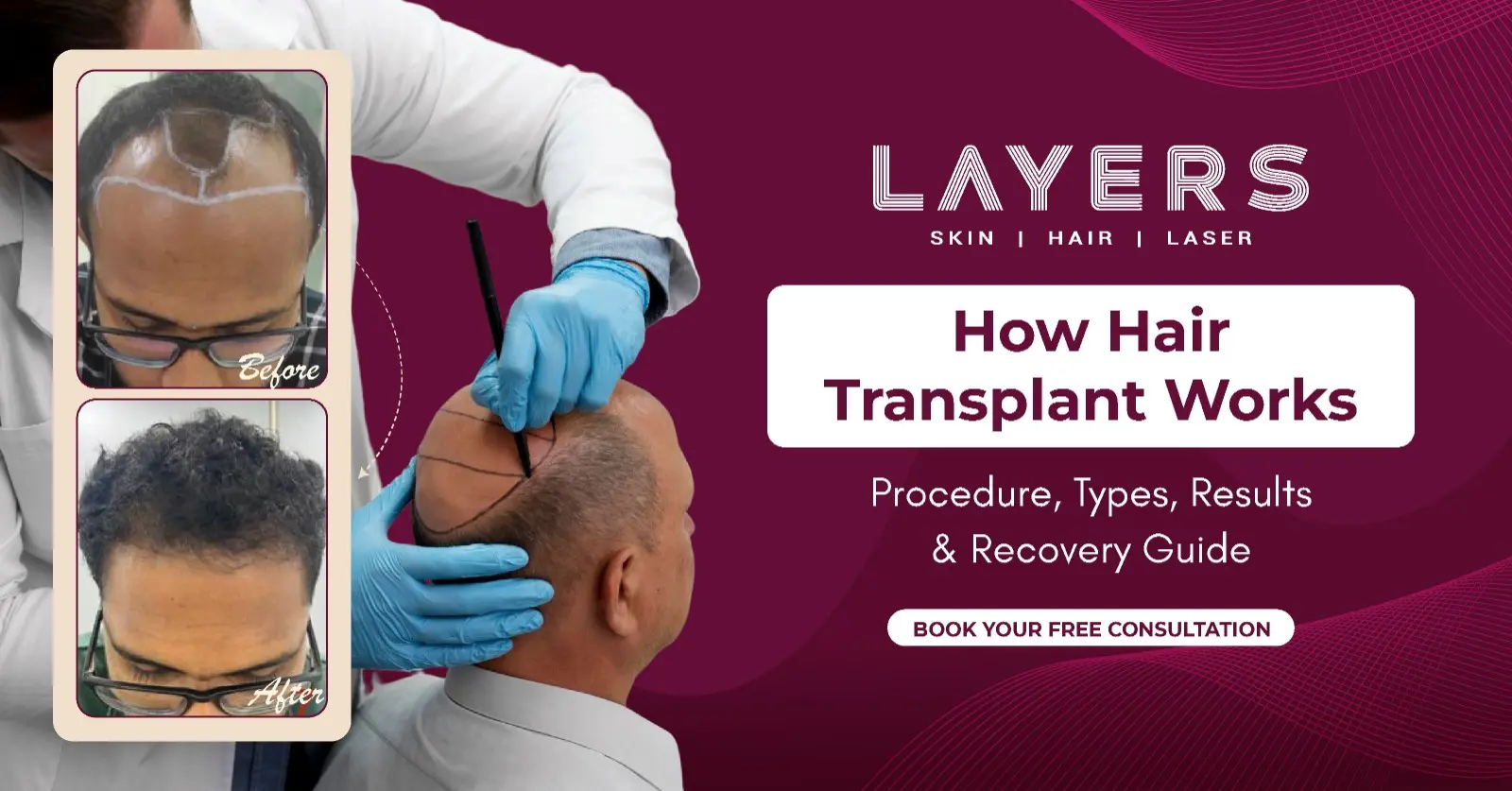
Hair thinning and baldness impact most individuals, and there’s no concern for it for anyone from restricting. It impacts confidence and overall appearance. The remarkable guidance from Layers Clinics on how hair transplants works can be the prominent solution that restores your hair thinning, regrows hair, and presents you with a youthful look wherever you go.
Let us reveal the curtains and explore how hair transplant at Layers Clinics works and the procedure we follow for your natural, heroic shine and look.
How Hair Transplant Works
A hair transplant is about deriving healthy follicles from a donor area and injecting them back into the places where hair thinning or baldness exists. This procedure is minimally invasive yet delivers natural, everlasting results that appear smoothly with your existing hair.
Choosing a reputed clinic like us for how hair transplant works increases your chances of accessing advanced treatments. Dating back to the 1950s, hair transplantation remains the permanent solution for any pattern hair loss.
Hair Loss Conditions Treated
A hair transplant addresses multiple types of hair loss, including:
- Male pattern baldness
- Hair Thinning in Females
- Receding Hairline
- Patched bald spots
- Hair loss due to scars, injuries, or surgeries
Types of Hair Transplant Treatments at Layers Clinics
Layers Clinics offers advanced solutions for the most searched question – how hair transplant works, tailored to address various patterns and stages of hair loss. Our clinic offers globally competitive methods and treatment procedures to complement safe and naturally looking hair restoration.
When it comes to hair fall treatments, we recommend two primary methods that define how hair transplant works effectively in clinical practice. Offering distinct advantages, this makes you an informed choice:
Follicular Unit Extraction (FUE): In Follicular Unit Extraction, follicular units (groups of 1 to 4 hairs, typically) are removed individually with the aid of a micro-punch device (0.6 to 1.0 mm in diameter). While this method may produce minimal scarring (in the form of tiny, dot-like scars), these scars are nearly impossible to see, even with the hair removed. Due to the minimal recovery time and lack of visible scarring with this method, Follicular Unit Extraction is the most popular hair restoration method in the world even today.
Follicular Unit Transplantation (FUT): In Follicular Unit Transplantation, a thin patch of the scalp is removed from the donor area, and the follicular units (the hair groups) are removed from the prepared patch and individually examined with the aid of a microscope. This method is useful for patients with advanced hair loss since it produces a higher graft ratio for a single treatment. However, this method also has a long-term consequence of a visible, linear scar across the donor scalp area, although the surrounding hair will conceal it.
Both techniques follow a similar growth principle. The transplanted follicles are permanent, and what you choose depends on the degree of hair loss, donor hair density, and lifestyle preferences.
Step-by-Step: How Hair Transplant Works Post Surgery
Understanding how a hair transplant works on the day itself removes much of the anxiety around the procedure. Here is the typical process:
- Consultation and Design: The surgeon maps the new hairline, considering facial proportions, age-appropriate density, and future loss patterns. This collaborative step brings natural-looking results.
- Local anaesthesia: The donor and recipient areas are numbed with anaesthesia. There can be mild discomfort during this phase, but the rest of the procedure is painless.
- Graft harvesting: Harvested grafts in FUE and FUT are placed in a cold solution to enhance their viability.
- Recipient site creation: The surgeon makes thousands of tiny incisions in the thinning area at the precise angles, depths, and directions to match natural hair growth patterns.
- Graft placement: Each follicular unit is carefully inserted into the prepared sites. A session can involve 1500-5000 grafts depending on the area covered.
- Post-procedure care: We provide detailed instructions post-surgery so that people can return to normal activities within a few days’ timeline.
Which Hair Transplant Method is Best for You?
Choosing between FUE and FUT depends on multiple clinical and lifestyle factors rather than a one-size-fits-all decision. While FUE is ideal for individuals who prefer minimal scarring and faster recovery, FUT is often recommended for patients with extensive baldness who require a higher number of grafts in a single session.
A personalized consultation evaluates:
- Extent of hair loss (Norwood scale)
- Donor area density and strength
- Scalp flexibility
- Lifestyle and recovery expectations
Modern clinics increasingly combine precision tools and advanced implantation techniques to maximize graft survival and ensure natural-looking density. The best method is the one that aligns with your long-term hair restoration goals.
Growth Timeline & Results
Being patient is crucial once you understand how a hair transplant works because results appear at a gradual pace. In 2-4 weeks, transplanted hairs shed. New hair growth happens after the third month, with wispy hairs sprouting and appearing. In 6-8 months, hair density develops.
The final results appear between 12 and 18 months, and the wait is worth the show because these hair strands are permanent, growing, and styling just like your natural hair.
FAQs
How to choose the best hair transplant clinic?
See their success stories, treatment methods, genuine nature, and one that offers advanced procedures along with aftercare.
How much does a hair transplant cost?
It depends on the number of grafts, technique, and condition of the hair. Packages are customized based on individual needs.
Is the procedure painful?
As local anaesthesia is considered, there will be no pain but a tingling sensation.
How much time will it take for the results?
Initial hair growth takes 3-4 months, while complete growth happens in 9-12 months.
Is a hair transplant safe?
Yes, when a reputed clinic like Layers takes the show, the procedure is safe and reliable.
Confidence Factor Beyond the Scalp
Research consistently proves that knowing how a hair transplant works and going through with it has profound psychological benefits. A study published in the Aesthetic Surgery Journal in 2024 found that nearly 9 out of 10 (87%) patients reported self-esteem enhancements within 1 year of attending their hair transplant appointment.
They felt much more self-assured while attending job interviews and social functions, as well as in their relationships with their partners. Confidence is a natural result when people’s outer appearances meet their inner feelings.
Conclusion
Hair transplantation is no longer just a cosmetic option but a scientifically advanced and reliable solution for permanent hair restoration. Understanding how hair transplant works, from selecting the right technique to following post-procedure care—plays a critical role in achieving natural and long-lasting results.
With evolving technologies like FUE and FUT, patients today can experience minimal downtime and maximum aesthetic improvement. The key lies in choosing the right clinic, accurate diagnosis, and a customized treatment plan.
If you are experiencing persistent hair loss or baldness, consulting an experienced specialist early can significantly improve your outcomes and restore not just your hair, but your confidence.
