
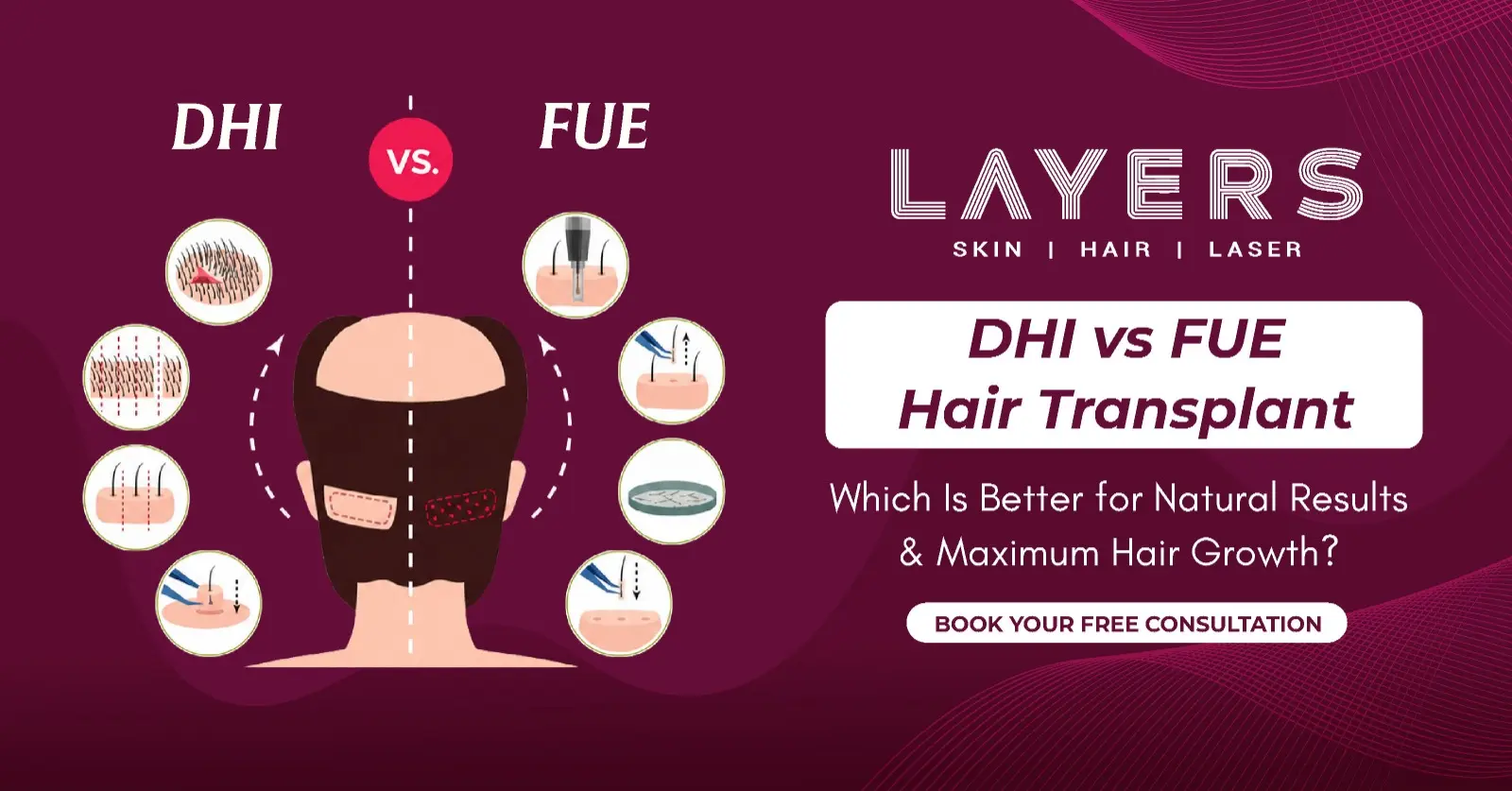
Hair transplantation is a surgical procedure that involves relocating healthy hair follicles from a donor area, mostly the back and sides of the scalp, where hair thinning is genetically resistant, to recipient areas where baldness or significant thinning is observed. During the past two decades, the evolution of hair transplantation has been high in nature, right from crude punch-graft methods to highly refined microsurgical techniques capable of offering natural looks and permanent results. Though the debate of DHI vs FUE Hair Transplant is long-standing, it’s the best approach if we narrate what you need to understand before choosing a treatment. In today’s landscape, the most advanced and highly performed treatments are DHI – Direct Hair Implantation and FUE – Follicular Unit Extraction.
Layers Clinics, indeed, has both DHI and FUE hair transplant procedures, carried out by experienced surgeons with world-class equipment. If there’s anything best, it comes based on what you choose. In this article, we dive deep into a balanced overview of DHI vs FUE hair transplant to help you in deciding the right treatment based on your concerns or needs.
Understanding FUE Hair Transplant
FUE, or Follicular Unit Extraction, is a minimally invasive hair transplant procedure. Here, the individual follicular units, having 1-4 hair strands each, are extracted from the donor area using a micro-punch tool with a 0.6 to 1.0 mm in diameter range. Each graft is then stored in a nutrient-rich solution before being implanted into a tiny recipient-site incision created in the bald area. FUE leaves no scars, has a quick recovery rate, and enables patients to choose short hairstyles without visible scarring.
In the context of DHI vs FUE hair transplant, FUE is often highlighted because it covers larger areas of baldness. In this process, the surgeon can implant a high number of grafts, almost 3,000-5,000, in a single session. We perform FUE hair transplant with precision micro-motors and magnification loupes so that there’s minimal follicle damage and extreme advantage.
Understanding DHI Hair Transplant
DHI, or Direct Hair Implantation, is a modified version of the FUE technique. The extraction process is similar to that of individual follicular units harvested using a micro-punch, but the implantation stage varies. Instead of pre-creating recipient incisions on your scalp and placing grafts into them, DHI uses a specialized pen-shaped device – Choi Implanter. This device creates the incision and places the graft in one single motion, enabling the surgeon to have great control over the angle, depth, and direction of each implanted hair.
When comparing DHI vs FUE hair transplant, the main advantage of this treatment is its precision. During the process, the grafts are directly injected into the area, driving better survival rates than FUE. DHI is a well-suited approach for hairline reconstruction, eyebrow transplants, and areas demanding high hair density. Our experts recommend DHI for patients who need massive hair growth in the frontal zone.
DHI vs FUE Hair Transplant: Side-by-Side Comparison
| Feature | FUE Hair Transplant | DHI Hair Transplant |
|---|---|---|
| Extraction Method | Micro-punch (0.6–1.0 mm) | Micro-punch (0.6–1.0 mm) |
| Implantation Method | Manual slit incisions + forceps placement | Choi Implanter pen (simultaneous incision + placement) |
| Ideal Coverage Area | Large areas (Norwood 4–6) | Smaller areas, hairlines, density boosting |
| Maximum Grafts Per Session | 3,000–5,000+ | 1,500–3,500 (may need multiple sessions for large areas) |
| Precision of Implantation | High | Very high (angle, depth, direction control) |
| Graft Survival Rate | 90–95% | 92–97% (reduced out-of-body time) |
| Shaving Required | Donor area shaved | Minimal or no shaving possible |
| Scarring | Tiny dot scars (virtually invisible) | Tiny dot scars (virtually invisible) |
| Recovery Time | 7–10 days | 7–10 days |
| Best For | Extensive baldness, body hair transplants | Hairline design, eyebrow transplants, density enhancement |
| Cost (Relative) | Moderate | Higher (specialised tools + technique) |
| Session Duration | 6–8 hours | 6–10 hours (slower implantation per graft) |
Advantages of FUE Hair Transplant
When drawing a thin line with DHI vs FUE hair transplant, FUE brings several exceptional advantages:
- Highly efficient for covering larger areas, such as high baldness
- Comprehensive restoration happens in a single session
- Versatile as it extracts from body donor sites when scalp donor density is low
- Cost-effective solution per graft, and patients can access it when high graft counts are needed
Layers Clinics recommends FUE for patients needing maximum coverage with optimal cost efficiency.
Advantages of DHI Hair Transplant
On the other side of the DHI vs FUE hair transplant evaluation, DHI has its own significance:
- Implantation precision is comparatively higher, with exact control over how each graft is placed on the scalp. Leads to naturally looking hairlines
- Transplantation is possible without shaving the recipient area.
- As grafts are implanted directly into the Choi pen, they spend less time outside the body, while enhancing faster hair growth.
DHI for hairline reconstruction is a density-enriching choice in partially thinning areas and eyebrow transplantation.
Which Should You Choose – Layers Clinics’ Perspective
When it comes to the DHI vs FUE hair transplant decision, it depends on your personal choice. The factors include the extent of hair loss, your desire and expectations, cost, and other aesthetic goals. We recommend our patients to choose a hybrid approach, as FUE for covering larger areas and DHI for the hairline and frontal zone. In our experience, the combination of the two delivered the best of the unimaginable.
If you’re consulting our experts, our surgeons will have the wheel to assess your donor density and align with your expectations. They will recommend the best possible approach within the DHI vs FUE hair transplantation is what you’re battling your thoughts with. Be it choosing one method or the dual, you can trust Layers Clinics because we deliver natural and lasting results with the top-notch standards of surgical process and hypercare.
Take the Next Step with Layers Clinics
DHI and FUE hair transplants are advanced techniques for permanent hair restoration. FUE is ideal for covering large bald areas with high graft numbers, while DHI offers precise implantation for natural hairlines and density. The best choice depends on hair loss severity, desired results, and expert recommendation for optimal outcomes.
Choosing between DHI vs FUE hair transplant isn’t overwhelming when the right guidance is standing next to you. It is empowering to learn about these because either of these is setting you on the path of permanent hair restoration. The DHI vs FUE hair transplant journey goes personal, and we treat it both as such. So, we welcome you on board for consultation as our expert team is here to assist you always.
Frequently Asked Questions
Which is better: DHI or FUE hair transplant?
Both DHI and FUE are advanced techniques, but the best choice depends on your hair loss pattern. FUE is ideal for covering large bald areas, while DHI offers higher precision for natural hairlines and density. A personalized consultation helps determine the most suitable option for you.
Does DHI give more natural results than FUE?
DHI can provide slightly more natural-looking results, especially in the hairline area, due to precise control over angle, depth, and direction. However, FUE also delivers highly natural outcomes when performed by experienced surgeons.
Which hair transplant method has better graft survival rate?
DHI typically has a slightly higher graft survival rate (around 92–97%) compared to FUE (90–95%) because grafts spend less time outside the body. Both methods are highly effective when performed under expert care.
Is DHI more expensive than FUE hair transplant?
Yes, DHI is generally more expensive than FUE due to specialized tools like the Choi implanter and the precision involved. FUE is more cost-effective, especially when a large number of grafts are required.
Which method is best for maximum hair density?
DHI is often preferred for achieving higher density, particularly in the frontal hairline and crown areas. It allows precise placement of grafts, making it ideal for patients looking for fuller, denser results.
