
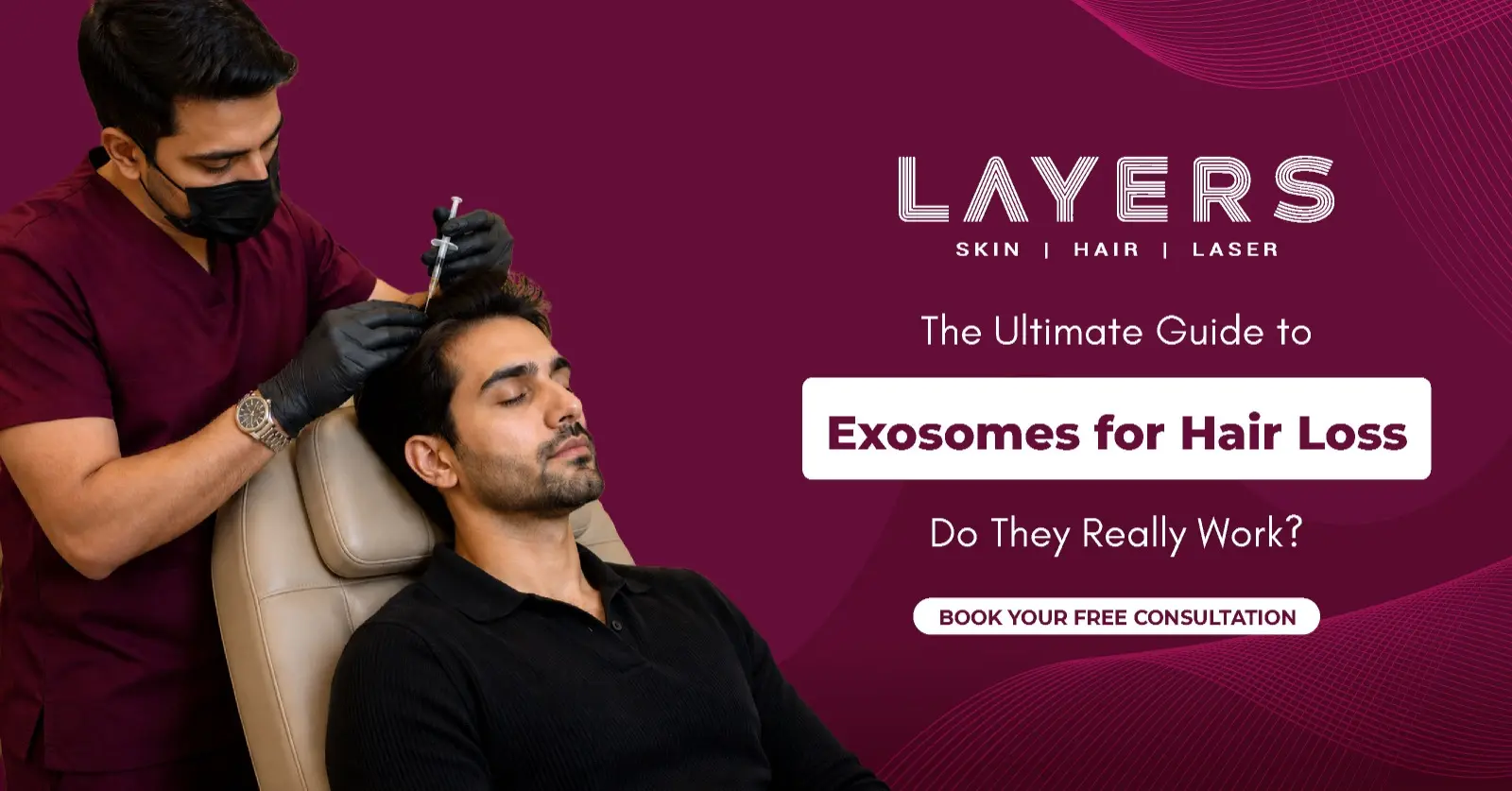
Dealing with a widening part or a receding hairline can be incredibly frustrating. If you have been researching modern hair restoration treatments lately, you have likely encountered the buzz surrounding exosomes for hair loss.
At Layers Clinics, we are witnessing a significant shift away from invasive surgeries as clients seek biotech-driven, non-surgical solutions. But what exactly are these microscopic elements, and do they truly represent a breakthrough in hair growth treatment?
If you’ve tried topical serums, supplements, and scalp massages with limited success, you are likely ready for something that works at a deeper level. Exosomes represent exactly that a biological solution targeting the cellular root cause of thinning hair.
What Are Exosomes for Hair Loss and Do They Really Work?
To understand how they work, it helps to look at how our cells communicate. Exosomes are nanoscale extracellular vesicles (roughly 30–150 nanometers in diameter) naturally secreted by stem cells. Think of them as the body’s molecular postal service or cellular “project managers” tiny lipid-wrapped signaling bubbles packed with biological instructions and delivered directly to recipient cells.
While they do not contain stem cells themselves (meaning there is zero risk of abnormal cell division), they are power-packed with:
- Growth Factors: Proteins that stimulate cellular division and tissue regeneration.
- Cytokines: Signaling molecules that regulate inflammatory responses and protect the scalp environment.
- MicroRNA: Genetic messengers that activate the specific biological pathways responsible for hair growth.
Do They Really Work?
The short answer is yes. Clinical studies have shown that exosomes target the absolute root cause of hair thinning: sluggish cellular communication. When injected or microneedled into the scalp, exosomes provide a highly concentrated signal to your hair follicles, effectively pushing them out of their resting state (telogen phase) and waking them up into the active growth stage (anagen phase).
Let’s dive deeper into the science, the real-world results, and what you can realistically expect from this revolutionary treatment.
Who Is an Ideal Candidate for Exosome Hair Treatment?
Exosome therapy is best suited for:
- Men and women experiencing early to moderate hair thinning (Norwood Scale I–IV for men; Ludwig Scale I–II for women)
- Individuals with diffuse thinning across the crown or temporal regions
- Patients who have undergone hair transplant surgery and want to maximize graft survival and density
- Those seeking a non-surgical, drug-free alternative to minoxidil or finasteride
- People who have tried PRP with partial results and want a more potent regenerative option
- Patients with telogen effluvium triggered by stress, illness, postpartum changes, or nutritional deficiency
Exosome therapy may be less effective for:
- Scalp areas that have been completely smooth and bald for 5+ years (follicles may be permanently scarred)
- Individuals with active autoimmune conditions that are not currently managed
- Patients with certain scalp infections or inflammatory dermatoses (treatment must be deferred until resolved)
The most reliable way to determine candidacy is a trichoscopy scalp analysis — a magnified assessment that reveals follicle density, miniaturization levels, and whether follicles remain viable. At Layers Clinics, this is always the first step.
Exosome Hair Treatment vs. PRP vs. Minoxidil vs. Hair Transplant
One of the most common questions we receive is: “How does exosome therapy compare to treatments I already know about?” Here’s an honest, side-by-side breakdown.
| Feature | Exosomes | PRP | Minoxidil (Topical) | Hair Transplant |
| Mechanism | Stem-cell-derived multi-signal vesicles | Platelet growth factors from patient’s blood | Vasodilator; prolongs anagen phase | Surgical follicle relocation |
| Invasiveness | Minimally invasive (injections) | Minimally invasive (blood draw + injections) | Non-invasive (topical) | Highly invasive (surgery) |
| Downtime | 24–48 hours | 24–48 hours | None | 1–2 weeks+ |
| Speed of Results | First changes: 6–8 weeks | First changes: 8–12 weeks | First changes: 3–6 months | Visible growth: 6–12 months |
| Growth Factor Concentration | Very High (standardized, potent) | Variable (depends on patient’s platelets) | N/A | N/A |
| Requires Ongoing Use | Maintenance every 6–12 months | Maintenance every 3–6 months | Daily, indefinite | No (but new loss continues) |
| Addresses DHT Damage | Yes (miRNA pathway modulation) | Partially | No | No |
| Suitable for Women | Yes | Yes | Yes (5% formula) | Yes (selected cases) |
| Risk of Scarring | No | No | No | Yes |
Bottom line: Exosome therapy currently offers the highest concentration of regenerative signals available in non-surgical hair restoration. PRP is a strong complement or entry-level option. Minoxidil maintains what you have but rarely reverses significant loss. Hair transplants remain the gold standard for advanced baldness but carry cost, risk, and recovery — and exosomes can significantly improve their outcomes when used post-procedure.
Hair Exosomes Before and After: What Real Results Look Like
Patients consistently report two distinct, measurable changes following exosome scalp treatment:
Change 1: Increased Hair Follicle Density
Trichoscopy measurements (follicles per cm²) show new terminal hairs emerging from previously single-hair follicular units. Areas that once had 1 hair per follicle begin producing 2–3 hairs per unit — the natural density pattern of a healthy scalp.
Change 2: Hair Shaft Structural Thickening
This is the change patients often find most visually impactful. Miniaturized hairs those fine, colorless baby hairs you can barely see undergo a process called follicular reprogramming. They progressively:
- Increase in shaft diameter
- Regain their natural pigment
- Grow faster and longer before shedding
Documented Hair Exosome Before and After Patterns:
Crown Thinning: The most responsive area. The characteristic “bald spot” or diffuse thinning across the vertex shows measurable closure in standardized photography by month 4–5.
Temporal Recession: Hairline exosome results are visible but slightly slower, given the more advanced miniaturization in these zones for many patients.
Part Widening (Women): The widened central part the hallmark of female pattern hair loss typically begins to narrow visibly by month 3, with near-closure seen at month 6 in ideal candidates.
Important note on photography: Hair looks different depending on lighting, hydration, and styling. Ask your clinic to use standardized trichoscopy and macro-photography at each visit so you have objective evidence of progress not just mirror impressions.
Hair Exosome Results Timeline: Month by Month
Regrowing hair is a biological process that takes time. Since hair grows at an average rate of about half an inch per month, results will develop gradually. Here’s a typical timeline after your sessions at Layers Clinics:
Month 1: Cellular Activation & Reduced Shedding (Weeks 1 – 4)
On the surface, it may seem like nothing is happening, but beneath the scalp, cellular repair is in full swing. Many patients report a significant decrease in daily hair shedding by the end of the first month.
Months 2 – 3: The Awakening of Baby Hairs (Weeks 5 – 12)
This is when the magic starts to become visible. You will begin to notice fine, short, downy hairs emerging along your hairline or parting where the follicles were previously dormant.
Months 4 – 6: Peak Density & Structural Thickening (Weeks 13 – 24)
The fine hairs that appeared in earlier months begin to mature, taking on your natural color and texture. Overall hair density increases, making it easier to manage your style and significantly reducing visible scalp exposure.
Can Exosomes Treat Male Pattern Baldness?
Male pattern baldness, or androgenetic alopecia, is driven by genetic sensitivity to dihydrotestosterone (DHT). DHT binds to hair follicles, shrinking them until they stop producing visible hair altogether.
Exosomes are particularly well-suited to combat male pattern baldness because they promote angiogenesis (the formation of new blood vessels). By establishing a more robust blood supply around the base of the hair follicle, exosomes ensure that essential nutrients and oxygen reach the roots, even in the presence of DHT.
The Golden Window: Exosomes are especially effective for men experiencing early to moderate stages of male pattern baldness (receding hairlines or thinning crowns). However, in cases where a scalp area has been completely bald and smooth for many years, the follicles may have scarred over. In such advanced cases, a hair transplant might still be necessary, though exosomes are often used post-transplant to enhance graft survival rates.
Exosome Hair Loss Treatment for Women
Female hair loss — typically presenting as diffuse thinning across the crown with a widening part rather than receding hairlines responds excellently to exosome therapy.
Why Women Respond Well
Women with female pattern hair loss (FPHL/androgenetic alopecia) or telogen effluvium retain a higher proportion of miniaturized (but still viable) follicles compared to men at similar stages of hair loss. This larger pool of rescuable follicles means more material for exosomes to work with.
Common Female Hair Loss Triggers Exosomes Can Help With:
- Postpartum hair loss (telogen effluvium following childbirth — typically peaks at 3–6 months postpartum)
- Hormonal changes (menopause, PCOS-related androgen excess, thyroid disruption)
- Nutritional deficiency recovery (iron, ferritin, zinc, vitamin D depletion)
- Chronic stress-induced shedding
- Female pattern thinning (Ludwig Scale I–II)
Important Note for Women
Women who are pregnant or breastfeeding should defer exosome scalp therapy until after weaning, as a precautionary measure not because of documented risk, but because sufficient pregnancy-specific safety data does not yet exist
Exosome Hair Treatment Cost: What to Expect
Exosome hair therapy pricing varies based on several factors:
What Influences the Cost
- Exosome source and potency: Medical-grade exosomes derived from certified MSC cultures with validated growth factor concentrations cost more — but produce superior, more consistent results than lower-grade preparations
- Delivery method: Microneedling sessions (broader scalp coverage) vs. targeted injections
- Clinic expertise: Board-certified dermatologists and hair restoration specialists with specialized training command higher fees
- Geographic location: Metro clinics in Delhi, Mumbai, Bengaluru, and Hyderabad have different pricing structures
- Number of vials: Larger or more severely affected scalp areas require more exosome volume
Is Exosome Hair Therapy Worth the Cost?
When evaluated against the lifetime cost of minoxidil (daily, indefinite use), the expense of hair transplant surgery, and the psychological cost of progressive hair loss on confidence and quality of life, most patients find exosome therapy delivers strong value especially when maintenance sessions sustain results for 12+ months.
Side Effects and Safety: What You Need to Know
Exosome hair therapy has an excellent safety profile — but informed patients make better patients. Here is a transparent overview:
Common (Expected) Post-Treatment Effects
These are normal responses that resolve within 24–72 hours:
- Mild scalp redness and warmth at injection/needling sites
- Temporary swelling of the scalp or upper forehead (if hairline was treated)
- Minor tenderness or sensitivity when touching the scalp
- Small pinpoint marks at injection sites
Rare Side Effects
- Temporary increased shedding in weeks 2–3 (the “shedding phase” as follicles cycle out before growing back stronger)
- Mild headache (usually resolves same day)
How to Prepare for Your First Hair Exosome Treatment
To ensure that your scalp effectively absorbs the maximum amount of signaling proteins and experiences minimal irritation, some preparation is essential. Follow these steps in the days leading up to your appointment:
1. Pause Anti-Inflammatory Medications: 3 to 5 Days Before
Avoid taking over-the-counter anti-inflammatories such as ibuprofen, aspirin, and high-dose vitamin E supplements. These can thin the blood and increase the likelihood of minor bruising at the injection sites.
2. Hydrate Your Body Thoroughly: 24 to 48 Hours Before
Drink plenty of water in the days leading up to your treatment. Well-hydrated skin heals faster and responds more effectively to cellular therapies.
3. Wash Your Hair with a Gentle Shampoo: Morning of Treatment
On the day of your appointment, shower and thoroughly clean your hair and scalp with a basic, mild shampoo. Do not apply hairsprays, styling gels, dry shampoos, or leave-in conditioners afterward, as the scalp must be perfectly clean.
4. Eat a Solid Meal: 1 to 2 Hours Before
Have a balanced snack or meal before coming to Layers Clinics. Keeping your blood sugar stable will help you feel relaxed and comfortable throughout the quick micro-injection process.
Aftercare: Maximizing Your Results Post-Treatment
What you do in the 72 hours following your session significantly influences outcomes. Follow these post-treatment guidelines:
First 6 Hours
- Do not touch, scratch, or press on the treated scalp
- No hair washing for at least 8–12 hours
- Stay indoors or out of direct sunlight — UV exposure to a recently treated scalp increases inflammation risk
- Avoid bending over or inverting your head (no yoga headstands!)
First 48–72 Hours
- No vigorous exercise — elevated body temperature and sweat can irritate micro-channels and reduce exosome uptake
- No saunas, steam rooms, or hot baths (warm showers are fine after 24 hours)
- No alcohol — it promotes inflammation and dilates blood vessels
- Avoid harsh shampoos — use only a mild, sulfate-free formula for the first week
First 2 Weeks
- Avoid chemical scalp treatments (color, perms, relaxers)
- Minimize tight hairstyles that pull on the scalp (tight braids, ponytails, hair extensions)
- Use a silk or satin pillowcase to reduce friction on treated follicles
Ongoing Support
- Continue any prescribed topical treatments (such as minoxidil, if applicable) — exosomes and minoxidil work synergistically
- Maintain adequate protein intake (hair is primarily keratin — protein is the raw material for growth)
- Address any underlying nutrient deficiencies (iron, ferritin, zinc, biotin, vitamin D) with blood work
Frequently Asked Questions
Are exosomes FDA approved for hair loss?
As of 2025, exosomes used in hair restoration are regulated as biologics in India and are available at licensed medical clinics. In the US, the FDA has not yet granted specific approval for exosome hair therapy but it is widely administered under physician supervision as a regenerative procedure. Always ensure your treatment is performed by a qualified dermatologist or hair restoration specialist.
How long do exosome hair results last?
Most patients enjoy sustained results for 12–18 months after their initial course. Maintenance sessions every 9–12 months help extend and build upon results.
Can I combine exosomes with PRP?
Yes — and many clinics, including Layers Clinics, offer combination protocols. Exosomes provide the molecular signaling depth; PRP adds additional autologous (your own) growth factors. The combination often produces faster initial results.
Can exosomes help if I have alopecia areata?
Early research is promising. Exosomal anti-inflammatory cytokines may help calm the immune attack underlying alopecia areata. However, alopecia areata has a complex autoimmune mechanism, and exosome therapy should be considered an adjunct to (not replacement for) immunomodulatory treatment.
Does exosome therapy hurt?
Discomfort is minimal. A topical numbing cream is applied 30–45 minutes before micro-injections, ensuring most patients experience only mild pressure rather than pain. The procedure typically takes 30–60 minutes.
Ready to Reclaim Your Hair with Exosome Therapy?
Exosomes for hair loss represent a genuine scientific leap not marketing hype. By targeting the cellular communication breakdown that underlies virtually every form of hair thinning, exosome scalp therapy offers what most treatments cannot: real, structural regrowth without surgery, without systemic side effects, and without daily compliance requirements.
The science is clear. The results are measurable. The question is simply whether now is the right time for you.
At Layers Clinics, your journey starts with a comprehensive scalp analysis a detailed, trichoscopy-based assessment that tells us exactly which follicles are viable, how severe miniaturization is, and what treatment protocol will deliver the best outcome for your specific pattern of hair loss.
