
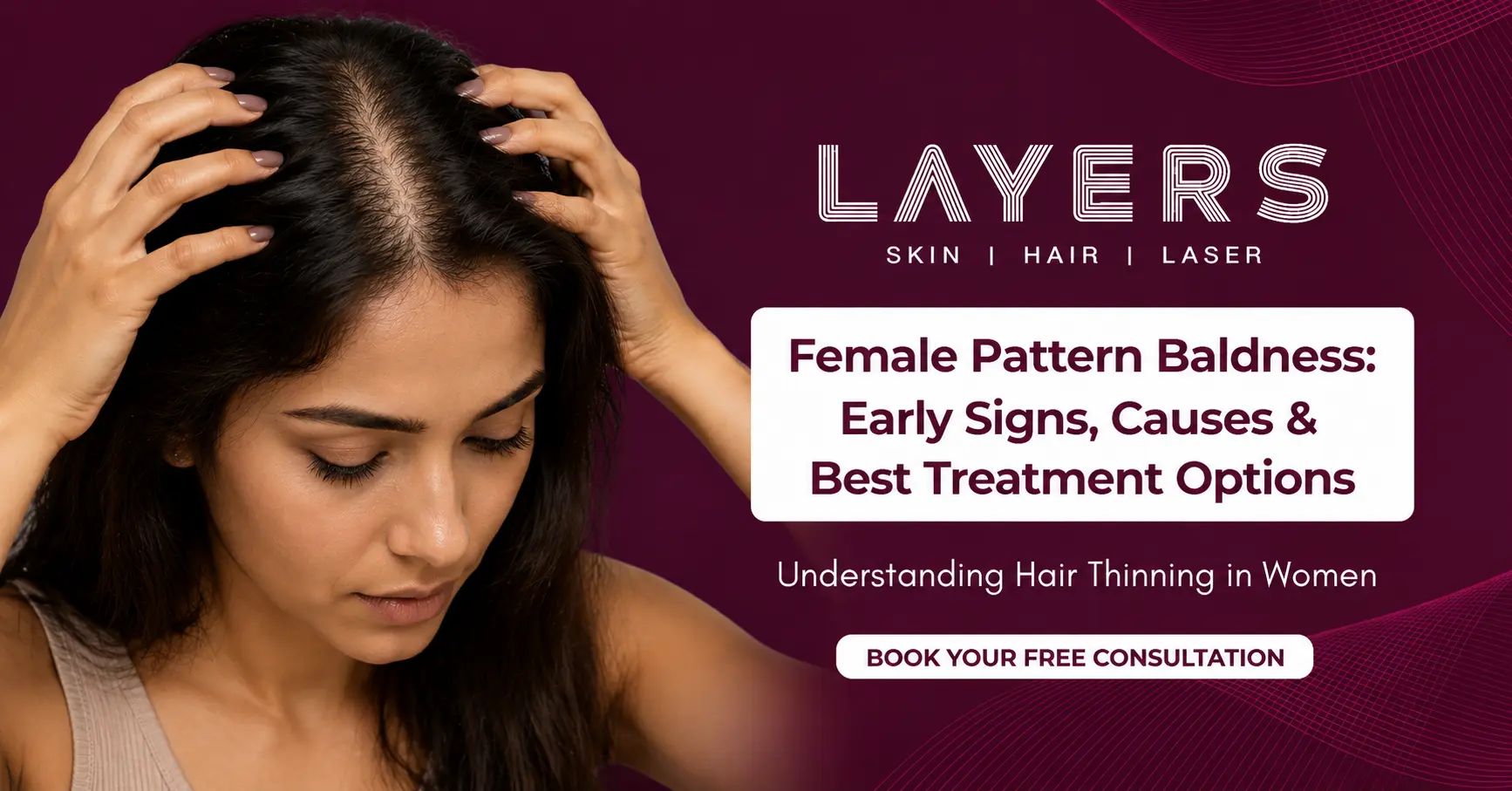
If you have noticed that your ponytail is getting thinner, then you are not alone. Is the scalp more noticeable when there is a strong light? Or are you finding more hair than usual on your pillow or shower drain? Although most women think that hair loss is only temporary, these slight modifications may be signs of the most common type of baldness in women around the world: female pattern baldness.
We know that hair is a significant part of confidence, identity and self-esteem at Layers Clinics. This is why our experts specifically determine the underlying cause of hair loss and then prescribe personalized treatment plans. Whether you are in early stage of thinning hair or the advanced stages, the earlier you get diagnosed then the better the results you’ll achieve.
We will cover all the information you will need to know about female pattern baldness – its signs and symptoms, causes, diagnosis and treatment options available today.
What is Female Pattern Baldness?
Pattern baldness in women is a type of hair loss that is caused mainly by genes and hormones and is a progressive condition. Whereas men tend to go bald, women do not. Rather, they have thinning hair along the crown and top of the head, but keep the line of the forehead.
It is called Female Pattern Hair Loss (FPHL) or androgenetic alopecia in women in the medical community.
It will gradually progress over a few years, so it is important to detect it early for successful intervention.
Why Female Pattern Baldness is Becoming More Common
Today, more women are suffering from female pattern baldness than ever before due to modern lifestyles.
This trend is due to a number of factors:
- Increased stress levels
- Hormonal disorders
- PCOS
- Thyroid disorders
- Poor nutrition
- Pollution
- Chemical hair treatments
- Genetics
- Aging
While genes are the main cause of thinning hair, environmental influences can also speed up the process.
Early Signs of Female Pattern Baldness
Recognizing the early symptoms can make treatment far more effective.
1. Widening Hair Part
A slowly increasing hairline is one of the initial indications.
Women do not experience hair loss in patches, but notice that the center part seems wider than usual.
2. Reduced Hair Volume
When you’re styling your hair into a ponytail, it might not seem as thick as it used to.
The first sign that often alerts many women to the need to tighten the ponytail is when it starts to come undone or wrap around twice in the hair clips.
3. Visible Scalp
Women may be experiencing female pattern baldness if their hair is more visible when they are in the sun or near bright light indoors.
4. Increased Hair Shedding
A second early warning sign is if you discover more strands when you’re combing, shampooing or styling your hair.
5. Slow Hair Growth
Each hair cycle results in less and shorter hair.
Over time, the hair doesn’t grow back as dense.
What Causes Female Pattern Baldness?
Thinning hair is not likely to be caused by just one thing.
Rather, there are several changes that occur in the body which lead to female pattern baldness.
1. Genetics
Family history is the most important risk factor.
If your mom, granny or someone in your family has been thinning, your odds are much greater.
2. Hormonal Changes
Hormones have a significant role in controlling hair growth.
Changes during:
- Menopause
- Pregnancy
- Childbirth
- PCOS
- Hormonal imbalance
May contribute to, or exacerbate, FPH.
3. Aging
As the body grows older the hair follicles shrink.
Once women reach age 35, they may start to notice thinning hair.
4. Medical Conditions
There are some conditions that can worsen the hair thinning:
- Thyroid disorders
- Iron deficiency
- Vitamin D deficiency
- Autoimmune disorders
- Chronic illnesses
- Lifestyle Factors
5. Lifestyle Factors
Examples include:
- Poor sleep
- Smoking
- Crash dieting
- Chronic stress
- Protein deficiency
Stages of Female Pattern Baldness
The Ludwig Scale is a system used by doctors to typically classify female pattern baldness.
Stage 1
Minimal thinning.
Only a slight widening of the hair partition.
This is when treatment is most likely to be effective.
Stage 2
Some hair thinning is seen.
Scalp becomes more visible.
The thickness of your hair becomes less.
Stage 3
Heavy to moderate thinning throughout the crown.
There is significant hair loss.
Professional intervention is necessary.
How is Female Pattern Baldness Diagnosed?
Layers Clinics diagnosis is not just an examination of the scalp.
Our specialists evaluate:
- Hair density
- Hair shaft thickness
- Medical history
- Family history
- Hormonal profile
- Nutritional deficiencies
- Lifestyle habits
Advanced scalp imaging can be used to decide the exact stage of female pattern baldness so that a personalized treatment plan can be created.
Best Treatment Options for Female Pattern Baldness
There is no ‘one size fits all’ treatment.
The best treatment depends upon the stage, cause, age and health of the patient.
1. PRP Therapy
The treatment is known as Platelet Rich Plasma (PRP) therapy, which uses a patient’s own growth factors to stimulate dormant follicles.
Benefits include:
- Increased hair density
- Reduced shedding
- Improved hair thickness
- Faster follicle recovery
The PRP is an effective treatment for early and moderate female pattern hair loss.
2. Growth Factor Therapy
Growth factor treatments wake up dormant hair follicles and promote scalp health.
These therapies can help prolong the growth phase of the hair cycle and can also minimize the miniaturization of hair follicles.
3. Low-Level Laser Therapy (LLLT)
Laser therapy stimulates blood flow in the area surrounding hair follicles.
Benefits include:
- Better oxygen supply
- Improved follicle function
- Reduced inflammation
- Stronger hair growth
4. Medical Management
Depending on the diagnosis, dermatologists may prescribe drugs that can help to slow the progression of female pattern baldness and promote healthy new hair growth. Treatment is always individual, based on a full medical exam.
5. Hair Mesotherapy
The action of Hair Mesotherapy involves injection of vitamins and amino acids, peptides and essential nutrients directly into the scalp.
This helps to keep follicles healthy along with other treatment methods.
6. Hair Transplant
If you are a woman that has advanced female pattern baldness and your hair follicles don’t seem to be moving anywhere, hair transplantation can help to restore the natural look and density.
Modern techniques provide:
- Natural hairline
- Permanent results
- Minimal downtime
- High graft survival
Layers Clinics is a clinic with professional hair transplant doctors that conducts advanced hair transplantation techniques according to the unique plan for each patient.
Lifestyle Changes That Support Treatment
The best results from medical treatment are achieved along with healthy habits.
Lifestyle changes recommended include:
- Eat protein-rich foods
- Correct iron deficiency
- Improve sleep quality
- Manage stress
- Avoid excessive heat styling
- Limit chemical treatments
- Maintain scalp hygiene
- Stay hydrated
These habits are important to ensure that treatment is most effective.
Case Study: How Layers Clinics Helped Restore Confidence
Over a span of 3 years, Priya had noticed that her hairline was gradually receding after which she made it to Layers Clinics. She had used various home remedies, costly oils, and over the counter remedies, but her hair never thickened.
Our experts performed a comprehensive consultation, scalp analysis and blood testing and determined that the condition was in the early to moderate stage, and it was caused by hormonal imbalance and iron deficiency.
She had a customized treatment plan which included:
- PRP Therapy sessions
- Treatment under dermatologist care
- Nutritional correction
- Hair growth supplements
- Personalised hair care regimen
The hair loss slowed down after 4 months. At the end of the 7th month, hair density was clearly improved, and the widening hair part was not very visible, and the appearance of new healthy hair growth was seen throughout the crown.
Most significantly, Priya felt a lot more confident and didn’t feel the necessity to conceal thinning places in her hair by styling it.
This journey shows how early diagnosis and tailored treatment from Layers Clinics can make a world of difference in dealing with female pattern baldness.
Myths About Female Pattern Baldness
Myth 1: Only older women experience hair loss.
Fact: Women in their twenties and thirties can also develop female pattern baldness.
Myth 2: Hair oils can reverse genetic hair loss.
Fact: Oils condition hair, but can’t regrow hair follicles that are genetically lost.
Myth 3: Frequent shampooing causes baldness.
The truth is that shampooing gets rid of dead hairs but doesn’t lead to female pattern baldness.
Myth 4: Hair loss is always permanent.
The truth is that if a woman can find the right treatment and diagnosis early, she can make progress and improve the density of her hair.
When Should You Visit a Hair Specialist?
If you see:
- If the balding persists for more than 3 months.
- Widening hair partition
- Increased scalp visibility
- A genetic history of hair loss.
- Excessive daily shedding
- Reduced hair volume
The earlier treatment, the better the chances of retaining the existing hair.
Why Choose Layers Clinics for Female Pattern Baldness Treatment?
Everyone’s treatment at Layers Clinics starts with the individual, not the hair loss.
Our approach includes:
- Comprehensive scalp analysis
- Personalized diagnosis
- Widely practiced doctors of hair replacement.
- Therapies of PRP and regeneration.
- Customized treatment plans
- Long-term follow-up care
- Current technology and evidence based procedures.
We feel the key to successful treatment is finding the cause, not the cure.
Conclusion
Having female pattern baldness can be hard on the spirit, but shouldn’t be a barrier to self-assurance and a bright future. The earlier you catch the symptoms and get treatment, the more you can do to stop hair loss and regrow healthier, thicker hair.
Layers Clinics offers cutting-edge diagnostics, experts, and customized treatment plans to help women enjoy long-lasting hair restoration results. From the first sight of thinning hair to years of hair loss, our team is here to support you along the way.
If you have been waiting to see a health care provider, it’s time to do so. Make an appointment with the specialists at Layers Clinics, and learn which option is best for you and your hair and scalp type to combat female pattern baldness.
Frequently Asked Questions
1. Can female pattern baldness be reversed?
Although cure is not always possible, early diagnosis and targeted treatments can greatly slow down the progression, increase hair thickness and promote healthier hair growth.
2. What is the best treatment for female pattern baldness?
Treatment depends on the cause and stage of hair loss—the best treatment. After a thorough examination at Layers Clinics, options like PRP therapy, medical management, growth factor therapy, mesotherapy and hair transplantation may be recommended.
3. At what age does female pattern baldness usually begin?
It may begin in the twenties, but is more likely to develop after age 35 and during menopause when hormonal changes take place.
