
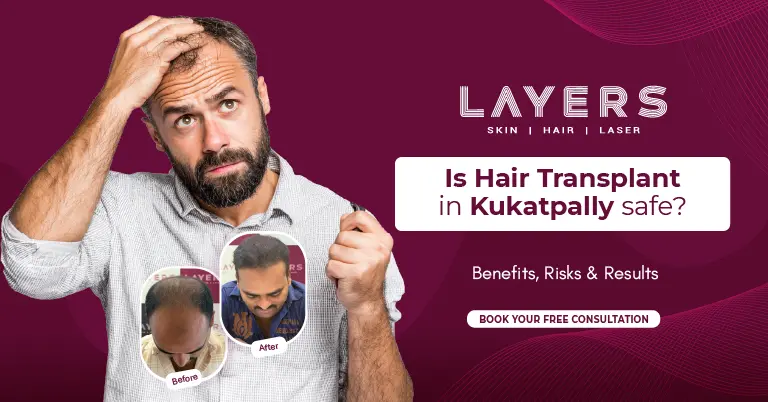
Hair loss isn’t just a cosmetic issue it affects confidence, self-image, and how comfortable you feel in social and professional settings. As hair restoration has become more accessible in Kukatpally, the question most people actually want answered before booking a consultation isn’t “does it work” it’s “is a hair transplant in Kukatpally safe?“
The honest answer: yes, when performed by qualified professionals using proper technique and clinical standards but safety isn’t automatic, and it’s worth understanding what actually determines it before you decide. This guide covers real risks, genuine benefits, a patient case study, and what results to realistically expect.
Is Hair Transplant Safe?
When performed by qualified professionals, hair transplantation is a safe, minimally invasive medical procedure. Advances in follicle extraction and implantation accuracy have significantly reduced complications and improved outcomes over the past decade.
At Layers Clinics, safety rests on a few non-negotiables: strict clinical sterilization protocols, individualized treatment planning, and experienced medical execution. That said, safety isn’t guaranteed by technology alone it depends on accurate diagnosis, the right technique for your specific case, and proper follow-up care. Skipping any of these significantly raises the risk of complications.
Understanding Hair Transplant Techniques
The technique used directly affects both safety and results.
1. FUE (Follicular Unit Extraction)
Individual hair follicles are extracted from the donor area and implanted into thinning or balding regions. FUE leaves minimal, nearly invisible scarring and offers faster recovery making it the preferred option for patients who want a less invasive procedure with a natural-looking result.
2. FUT (Follicular Unit Transplantation)
A strip of scalp tissue is removed from the donor area to harvest follicles. This allows more grafts to be transplanted in a single session, but recovery generally takes longer than FUE and leaves a thin linear scar at the donor site.
3. DHI and BHT (Where Applicable)
For patients needing maximum hairline precision or facing limited scalp donor supply, Direct Hair Implantation (DHI) and Body Hair Transplant (BHT) may also be assessed as options during consultation, depending on your case.
The right technique depends on the extent of your hair loss, donor hair availability, and your personal priorities not a default choice applied to every patient.
FUE vs. FUT at a Glance
| Factor | FUE | FUT |
| Scarring | Minimal, near-invisible dots | Thin linear scar |
| Recovery time | Faster | Longer |
| Grafts per session | Good, expandable across sessions | Higher yield in a single session |
| Can wear hair short | Yes | Not ideal |
| Best for | Most patients wanting minimal downtime | Cases needing very high graft counts |
Benefits of Hair Transplant in Kukatpally
When performed correctly, a hair transplant offers real, long-term benefits:
- Permanent results — transplanted follicles are genetically resistant to hair loss and continue growing naturally
- Natural appearance — modern technique allows transplanted hair to blend seamlessly with existing hair
- Improved confidence — hair restoration is frequently associated with a meaningful boost in self-esteem
- Low long-term maintenance — once healed, transplanted hair is cared for like normal hair, with no ongoing treatment required to sustain it
At Layers Clinics, the focus stays on natural density and long-term results tailored to the individual, not a standardized outcome applied to every patient.
Hair Transplant Risks and Side Effects
A hair transplant is not a high-risk procedure, but it is a medical one, and understanding the realistic risk profile matters more than being reassured it’s “completely safe.”
Common, expected side effects:
- Mild swelling or redness
- Scabbing in the treated area
- Itching during healing
- Temporary shedding of transplanted hair (shock loss) normal, not a sign of failure
Serious complications are uncommon, but risk increases significantly when the procedure is performed by unqualified practitioners or outside a proper clinical setting which is precisely why clinic and surgeon selection matters more than the technique itself.
Key Factors That Determine Safety
- Medical expertise — the surgeon’s skill and experience directly determine both the success rate and safety of the procedure
- Clinical environment — high hygiene standards and proper equipment reduce infection and complication risk
- Individualized treatment planning — every patient has a distinct hair pattern and donor area; personalized planning improves graft survival and natural-looking outcomes
- Post-procedure care — structured aftercare, medication, and scalp care are essential for proper healing and lasting results
Who Should Consider or Hold Off On a Hair Transplant?
Good candidates typically:
- Have a stable (not rapidly progressing) hair loss pattern
- Have sufficient donor hair density to support transplantation
- Are in good general health
- Have realistic expectations about gradual, long-term results
Consider waiting or seeking further evaluation first if you:
- Are under 25, when hair loss may still be actively progressing
- Have an uncontrolled medical condition requiring clearance first
- Have very limited donor hair density (a body hair transplant option may be assessed instead)
- Are looking for an immediate, dramatic transformation rather than a gradual, months-long process
Case Study: Successful Hair Transplant at Layers Clinics
The following is a representative patient case; individual results vary based on donor density, hair loss pattern, and adherence to aftercare.
A 32-year-old professional based in Kukatpally approached Layers Clinics with a receding hairline and crown thinning that had progressed over several years, affecting both appearance and self-confidence.
Initial assessment evaluated the extent of hair loss, donor area density, scalp condition, and lifestyle/medical history confirming the patient was a good candidate for an FUE-based transplant.
Treatment plan: A personalized plan focused on restoring a natural hairline and overall density, with careful attention to natural hairline design, even graft distribution, and minimizing scalp trauma during extraction and implantation.
Results over time:
- 1 month: Mild shedding of transplanted hair (a normal, expected phase)
- 3 months: First signs of new hair growth
- 6 months: Noticeably improved density and coverage
- 9–12 months: Full, natural-looking results
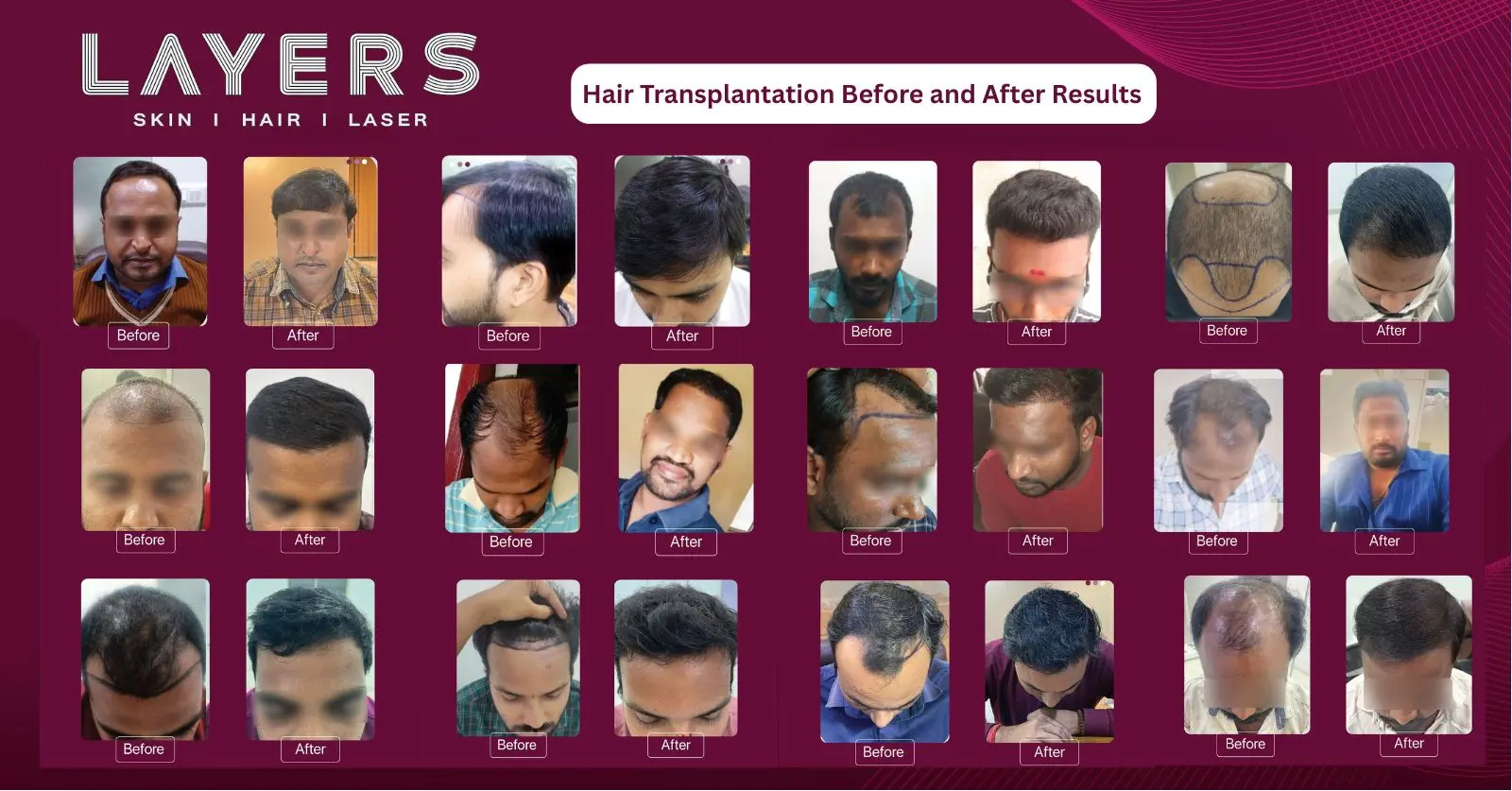
Outcome: The patient achieved a natural hairline, increased density, and a meaningful improvement in confidence and self-image illustrating that with the right technique selection and skilled execution, a hair transplant in Kukatpally can deliver safe, rewarding results.
What Results Should You Expect?
Hair transplant results build gradually this is a long-term investment, not a quick fix. Visible improvement typically begins within a few months, with full results generally achieved around the 9–12 month mark. The final outcome depends on graft quality, scalp condition, and how closely aftercare instructions are followed.
Hair Transplant Cost in Kukatpally
Cost depends on several factors:
- Number of grafts required — determined by hair loss extent and desired density
- Technique selected — FUE, FUT, DHI, or BHT each carry different pricing due to time and precision involved
- Surgeon experience — reflects surgical skill, not just clinic overhead
- Additional therapies, such as PRP, if combined with the transplant for enhanced results
Layers Clinics provides a transparent cost estimate after an in-person scalp assessment pricing shouldn’t be finalized without a proper evaluation of your specific case.
Why Choose Layers Clinics for Hair Transplant in Kukatpally?
- Experienced medical team — trained specialists in advanced hair restoration technique, minimizing complications through precise extraction and implantation
- Advanced technology — modern FUE and related techniques designed for natural-looking, high-survival-rate results
- Personalized treatment planning — every plan accounts for your unique hair pattern and donor area condition
- High safety and hygiene standards — strict sterilization protocols throughout the process
- Natural-looking results — hairlines designed around facial structure and natural growth direction
- Comprehensive aftercare — structured follow-up, scalp care guidance, and medication support for proper healing
- Long-term value — a permanent result that requires minimal ongoing upkeep once healed
Frequently Asked Questions
Is a hair transplant in Kukatpally safe for everyone?
It’s generally safe for most people, but suitability depends on factors like age, hair loss pattern, and donor hair availability. A consultation at Layers Clinics confirms whether you’re a good candidate.
Are hair transplant results permanent?
Yes. Transplanted follicles are resistant to hair loss and continue growing naturally. Maintaining overall hair and scalp health still matters for the best long-term appearance.
What are the risks after a hair transplant?
Most side effects mild swelling, redness, or temporary shedding are normal and resolve on their own. Serious complications are uncommon when performed at a qualified clinic.
Is there an age limit for getting a hair transplant?
There’s no strict upper limit, but candidates should have a stable hair loss pattern. Most surgeons recommend the procedure after age 25 for better long-term planning, since hair loss may still be progressing before then.
How do I know if my donor area is strong enough for a transplant?
A detailed scalp analysis evaluates donor density and follicle quality. Strong, healthy donor follicles are essential for good coverage and lasting results.
How much does a hair transplant cost in Kukatpally?
Cost depends on graft count, technique, and case complexity. An exact quote is provided after a scalp assessment at Layers Clinics.
How long is the recovery period?
Most patients see visible healing (redness, scabbing) resolve within about a week, with normal activities resumed within a few days full results take up to 9–12 months to mature.
Conclusion
So, is a hair transplant in Kukatpally safe? Yes, when performed by skilled practitioners in a properly equipped clinical setting. But technique alone isn’t what determines success; proper planning, precise execution, and diligent aftercare matter just as much.
With expert guidance from Layers Clinics, patients can pursue natural, long-term results with minimized risk. When considering a hair transplant, prioritize a clinic that treats safety, personalization, and realistic results as non-negotiable not just marketing language.
Book a consultation with Layers Clinics in Kukatpally to find out if you’re a good candidate.
