
Which Hair Loss Treatment Is Right for You?
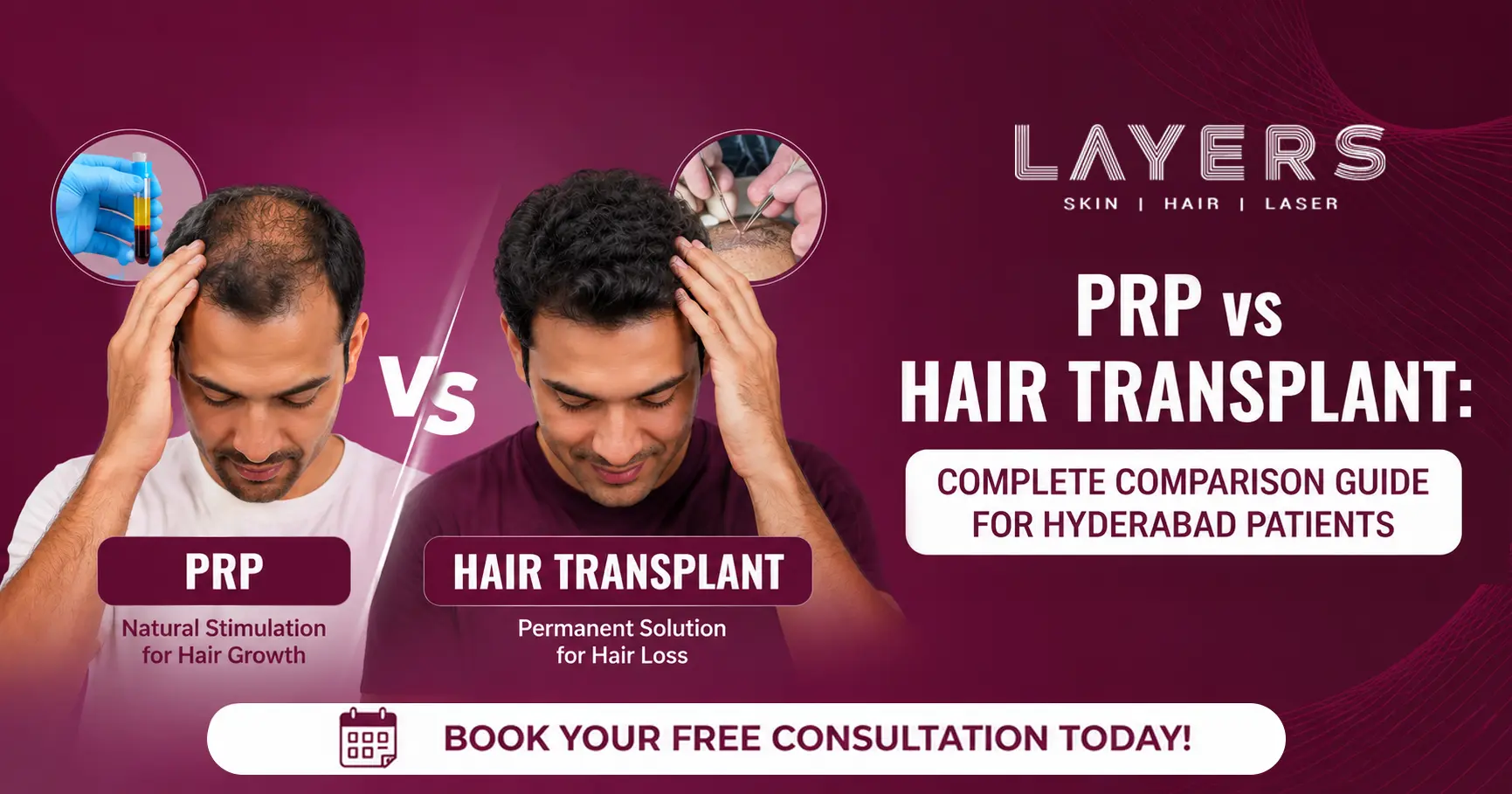
Hair loss affects 50% of men and 25% of women by age 50. When it happens to you, deciding between PRP vs Hair Transplant options is overwhelming.
The two most popular treatments today are:
- PRP (Platelet-Rich Plasma) — Regenerative medicine using your own blood
- Hair Transplant (FUE/DHI) — Surgical procedure moving hair follicles
Both work. Both get results. But they’re completely different treatments for different situations.
This guide compares them honestly so you can decide which is right for your hair loss stage, budget, and expectations.
What Is PRP for Hair Loss?
How PRP Works (The Science)
PRP stands for Platelet-Rich Plasma. Here’s the process:
Step 1: Blood Draw (10-15 mL of your blood)
Step 2: Centrifugation (spun in machine to separate platelets)
Step 3: Concentration (platelets extracted, 5-8x concentrated)
Step 4: Activation (calcium chloride added to activate growth factors)
Step 5: Injection (concentrated PRP injected into scalp in hair loss areas)
What’s Happening in Your Scalp?
The platelets release growth factors that:
- Stimulate hair follicles from dormant (telogen) to active (anagen) phase
- Improve blood flow to follicles (nutrients = hair growth)
- Reduce inflammation (DHT-related inflammation damages follicles)
- Strengthen existing hair (thickness improvement)
Key Point: PRP Doesn’t Create New Hair
This is crucial to understand: PRP cannot create hair where there is no follicle. It can only awaken dormant follicles or strengthen weak ones.
What Is Hair Transplant?
How Hair Transplant Works (The Surgery)
Hair transplant = Surgical relocation of hair follicles. Here’s the process:
Method 1: FUE (Follicular Unit Extraction)
- Individual hair follicles extracted from back of scalp (donor area)
- Extracted using motorized punch tool (0.8-1mm diameter)
- Follicles remain viable for 4-6 hours
- Surgeon creates tiny slits in bald area
- Each follicle manually implanted
- 2,000-4,000 follicles per session (8-10 hours)
Method 2: DHI (Direct Hair Implantation)
- Similar to FUE but uses implanter pen
- Follicles placed directly in scalp without pre-made slits
- Slightly higher graft survival (95%+ vs 90%)
- More expensive (Compared to other methods)
Key Point: Hair Transplant Creates Permanent Hair
Hair transplant moves follicles that are genetically resistant to DHT (male pattern baldness hormone). These follicles remain healthy in the new location—permanent solution.
Head-to-Head Comparison: PRP vs Hair Transplant
Treatment Comparison
| Factor | PRP | Hair Transplant (FUE/DHI) |
| What it is | Regenerative medicine (injection) | Surgical procedure (microsurgery) |
| Procedure type | Non-surgical, non-invasive | Surgical, invasive |
| Duration | 30-45 minutes | 6-10 hours (1 session) |
| Anesthesia | None (local numbing cream) | Local anesthesia |
| Downtime | None (can return to work) | 3-7 days (avoid strenuous activity) |
| Recovery | Immediate (no scars) | 2-3 weeks (visible healing) |
| Pain level | Minimal (injection discomfort) | Minimal (numbed during procedure) |
| Scarring | None | Minimal (linear scar at donor site, usually covered by hair) |
| Sessions needed | 6-12 monthly sessions | Usually 1-2 sessions (sometimes 3+) |
| Results timing | 3-4 months to see results | 3-4 months initial growth, 12 months full results |
| Permanence | Temporary (effects fade without maintenance) | Permanent (transplanted hair stays for life) |
Results Comparison
| Factor | PRP | Hair Transplant |
| Hair thickness | 30-40% improvement | 100% (new hair in bald area) |
| Hair density | Improves existing, doesn’t fill gaps | Fills bald areas completely |
| Hair count | Strengthens existing 20-30% | Adds 2,000-4,000 new hairs per session |
| Coverage | Works on thinning, not baldness | Works on baldness (completely bald areas) |
| Best for | Early/mid-stage hair loss | Advanced/complete baldness |
| Result appearance | Gradual thickening | More dramatic (new hair) |
When to Choose PRP: Ideal Candidates
PRP Works Best For:
- Early-stage hair loss (Norwood 1-3, Ludwig 1-2 scale)
- Diffuse thinning (hair loss across entire scalp, not patchy)
- Receding hairline (early recession, not complete baldness)
- Post-hair transplant maintenance (strengthen grafted hair)
- Hair shedding prevention (strengthen existing hair before it falls)
- Women with female pattern baldness (preserves natural hairline)
- People avoiding surgery (needle-phobic, afraid of downtime)
- First-time treatment (conservative approach before surgery)
PRP Success Rates by Hair Loss Stage
| Hair Loss Stage | PRP Success Rate | Expected Results |
| Grade 1 (minimal recession) | 70-80% | Stops loss, slight regrowth |
| Grade 2-3 (moderate loss) | 50-65% | Halts progression, some thickening |
| Grade 4+ (advanced loss) | 20-30% | Minimal effect (hair transplant better) |
Key insight: Earlier you start PRP, better the results. Advanced baldness requires transplant.
When to Choose Hair Transplant: Ideal Candidates
Hair Transplant Works Best For:
- Advanced hair loss (Norwood 4-7, significant baldness)
- Complete baldness in areas (crown, vertex completely bald)
- Receding hairline (wants dramatic hairline restoration)
- Permanent solution seekers (one-time procedure, lasting results)
- Young men (50+ year lifespan of transplanted hair)
- People with good donor hair (sufficient healthy follicles from back)
- Willing to take downtime (can accept 1-2 weeks recovery)
- Budget for one-time investment (prefer paying once vs ongoing)
Hair Transplant Success Rates
| Factor | Success Rate | Notes |
| Graft survival (FUE) | 85-95% | Most grafts take and grow |
| Hair growth rate | 90-100% | Of surviving grafts, nearly all grow hair |
| Satisfaction rate | 90-95% | Most patients very satisfied |
| 1-year results | 80-90% | Full density visible by 12 months |
| Long-term (10+ years) | 95%+ | Transplanted hair permanent |
Key insight: Hair transplant is highest satisfaction cosmetic procedure (90-95% satisfaction).
Timeline Comparison: Results You’ll See
PRP Results Timeline
| Timeline | Results & Expectations |
| Month 1-2 | Hair shedding stabilizes (less hair falling) Scalp feels healthier No visible hair growth yet |
| Month 3-4 | New baby hair growth visible (fine, light) Existing hair appears thicker Hairline recession appears halted |
| Month 6 | Noticeable thickening (5-15% improvement) Less hair shedding (fewer hairs on pillow) Confidence returning |
| Month 9-12 | Maximum results achieved (20-40% improvement typical) Hair texture improved Results plateau (maintenance required) |
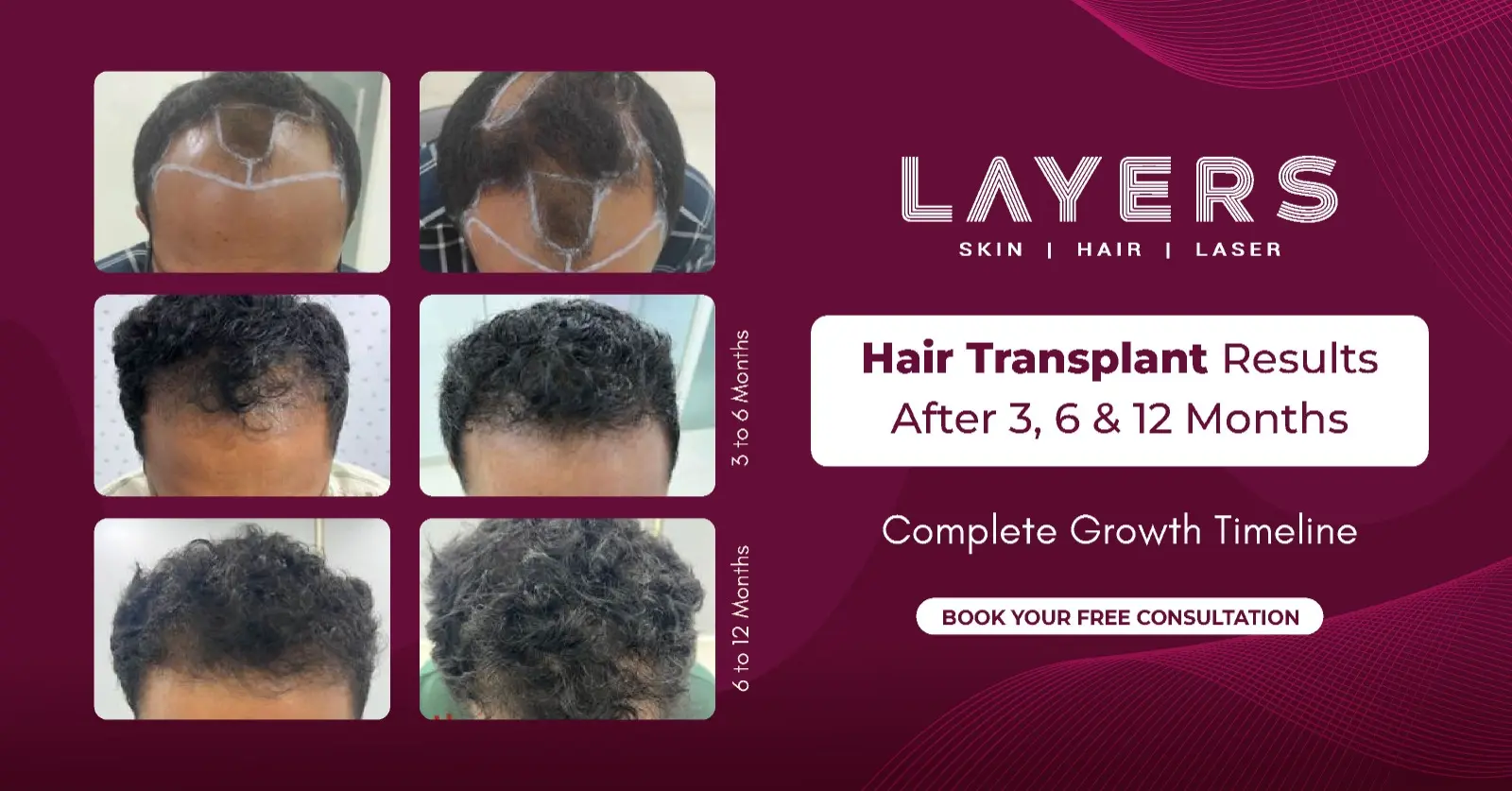
Hair Transplant Results Timeline
| Timeline | Results & Expectations |
| Day 1-2 | Transplanted hair visible Donor area bandaged Swelling and redness (normal) |
| Week 1 | Scabs forming (normal healing) Shock loss begins (transplanted hair sheds) Visible healing phase |
| Week 2-3 | Scabs fall off naturally Transplanted hair sheds as follicles enter dormant phase New growth cycle begins |
| Month 2-3 | First small hairs emerging Fine, light growth visible Early signs of success boost confidence |
| Month 4-6 | Noticeable hair growth Hair becomes thicker and darker Clear improvement visible |
| Month 9-12 | 80-90% of final density achieved Natural-looking results Hairline maturation nearly complete |
Decision Matrix: Which Treatment for You?
Choose PRP if:
- Hair loss is early-stage (just starting)
- You have diffuse thinning (not bald patches)
- You want to avoid surgery
- You can’t take downtime
- Budget is limited (starting treatment)
- You’re young and want to delay surgery
Choose Hair Transplant if:
- Hair loss is advanced (significant baldness)
- You have bald patches/areas
- You want permanent solution
- You’re willing to take 1-2 weeks downtime
- You can invest upfront (better long-term value)
- You want dramatic transformation
Choose Combined if:
- You want maximum results
- You can afford total investment
- You want to optimize long-term outcome
- You want to maintain results for life
Expert Opinion: Layers Clinics Dermatologists
According to Dr. Jagan (Hair Transplant Specialist, OMFS):
“PRP is excellent for early hair loss—it halts progression and strengthens hair. But advanced baldness needs transplant. The key is catching hair loss early. If you wait until Grade 5-6 baldness, PRP won’t help anymore. My advice: Start with dermatology evaluation. We assess your grade, genetics, and timeline to recommend the right approach.”
According to Dr. Bramara (OMFS Expert in DHT Hair Transplant):
“I recommend combined approach for best results. Transplant is permanent, but PRP maintains all hair (transplanted + native). Many patients focus only on transplant results and neglect surrounding hair—it continues thinning. Combined treatment prevents that. Think of it as: transplant plants new garden, PRP maintains the whole garden.”
Conclusion: Your Hair Restoration Path
The answer to “PRP vs Hair Transplant” is: It depends.
Quick Decision:
- Choose PRP if: Your hair loss is early and you want to try the least invasive option first.
- Choose Hair Transplant if: Your hair loss is advanced and you want a permanent, dramatic solution.
- Choose Both if: You want maximum results and can invest comprehensively.
Your Next Step:
Book free consultation at Layers Clinics:
- Professional trichology assessment
- Determine your hair loss grade (Norwood/Ludwig scale)
- Learn exact timeline and cost for YOUR situation
- Get personalized recommendation from hair specialist
Why Layers Clinics?
- Board-certified specialists (OMFS, Trichology experts)
- Both treatments offered (PRP + Transplant expertise)
- Transparent evaluation (honest assessment, not upsell)
- Proven track record (8,745+ reviews, 4.8 rating)
- Latest technology (FDA-approved equipment)
- Competitive pricing (No hidden cost)
- 10 locations in Hyderabad (convenient access)
