
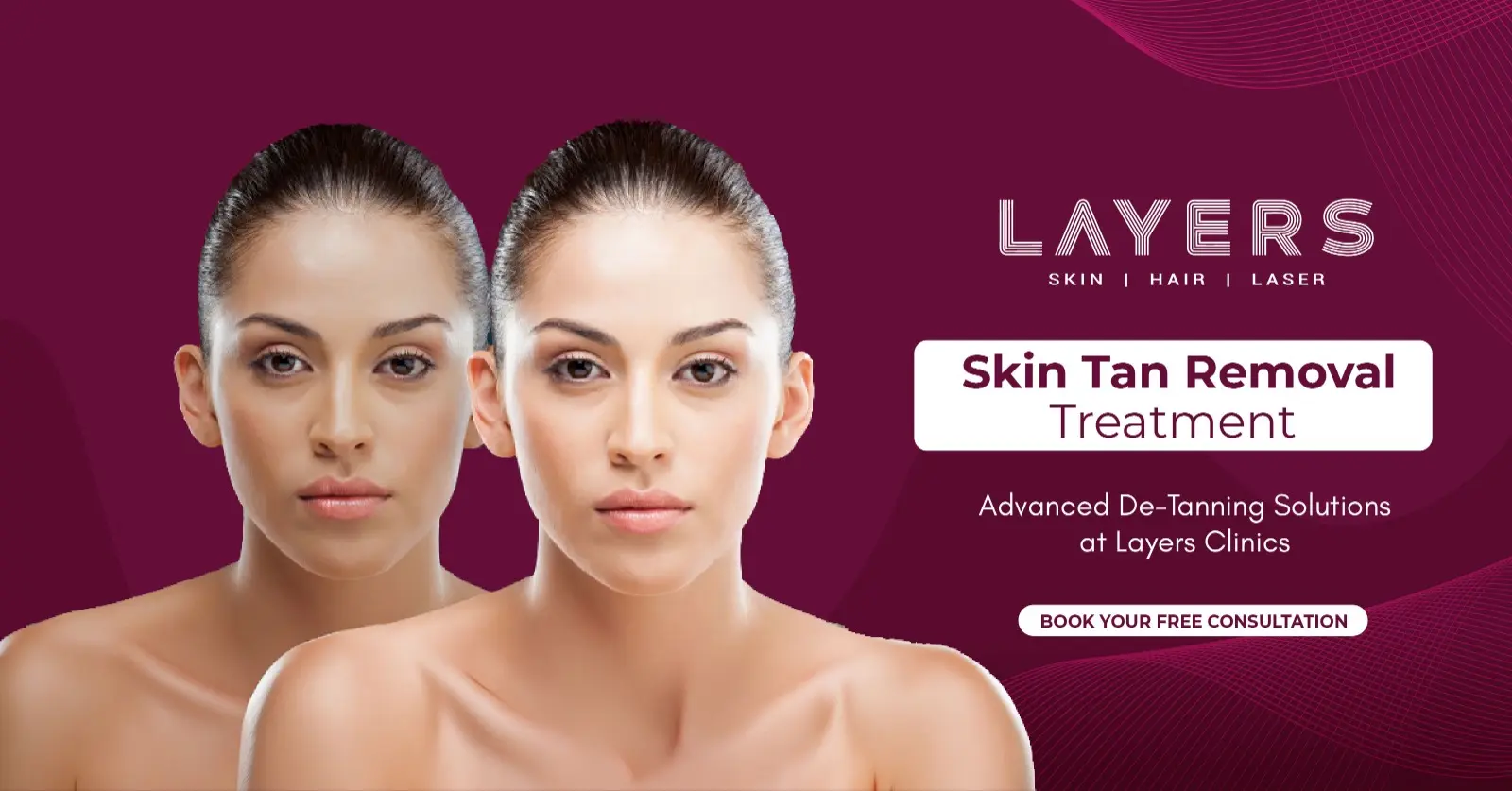
Skin tan removal treatment helps reduce the appearance of sun-induced tanning, uneven skin tone, and dullness caused by prolonged UV exposure. At Layers Clinics, we assess the skin condition first and recommend suitable options such as chemical peels, laser toning, carbon peel, and MediFacial treatments based on skin type, pigmentation, sensitivity, and treatment goals.
This guide is intended for people looking for skin tan removal in Hyderabad, including facial tan removal, neck tan removal, and professional de-tanning treatments, and for anyone comparing treatment options, sessions, costs, and expected results.
Quick answer: The appropriate tan removal treatment depends on whether the concern is simple sun tan or another pigmentation condition. Chemical peels, laser toning, carbon peels, and MediFacials may be considered after a professional skin assessment. Consistent sunscreen use is essential to maintain results.
What Causes Skin Tanning?
Skin tanning occurs when UV exposure stimulates increased melanin activity. Repeated exposure can make the face, neck, hands, arms, and other exposed areas appear darker or uneven compared with naturally covered skin.
Common causes include:
- Daily outdoor commuting
- Prolonged sunlight exposure
- Travel and holidays
- Outdoor sports and activities
- Insufficient sun protection
- Repeated exposure to intense sunlight
In addition to tanning, UV exposure contributes to photoaging and can worsen some forms of pigmentation. Therefore, tan removal should be approached as part of an overall skin-care and sun-protection routine.
Is It Sun Tan or Another Pigmentation Problem?
Not every dark patch is ordinary sun tan. Melasma, post-inflammatory hyperpigmentation, and other pigmentation concerns can sometimes resemble tanning.
Melasma, for example, can appear as brown or grey-brown patches, commonly on the cheeks, forehead, nose, or upper lip. Treating such pigmentation aggressively without identifying the cause may lead to irritation or unsatisfactory results.
For this reason, people considering professional tan removal treatment in Hyderabad should first have their skin assessed. The diagnosis helps determine whether de-tanning, pigmentation management, or another treatment approach is appropriate.
Best Skin Tan Removal Treatments at Layers Clinics
Different treatments address different aspects of tanning, pigmentation, texture, and dullness. At Layers Clinics, the treatment plan can be personalised according to the individual’s skin condition.
1. Chemical Peel for Tan Removal
A chemical peel for skin tan removal uses a professionally selected exfoliating solution to remove damaged superficial skin cells and improve uneven tone.
Depending on the skin assessment, formulations containing ingredients such as glycolic, lactic, or salicylic acid may be considered.
Chemical peels may be useful for:
- Facial tanning
- Dull skin
- Uneven skin tone
- Mild pigmentation
- Rough skin texture
The peel strength and frequency should be selected professionally, particularly for pigmentation-prone Indian skin.
2. Laser Toning for Skin Pigmentation
Laser toning uses controlled laser energy to target excess pigmentation. It may be considered for persistent pigmentation or uneven skin tone when a dermatologist determines that laser treatment is appropriate.
Laser treatment requires careful parameter selection according to skin type and pigmentation. A series of treatments may be recommended rather than relying on one session.
3. Carbon Peel for Tan and Dull Skin
A carbon peel, also called a Hollywood Peel, combines a carbon-based topical application with laser energy.
It may help improve:
- Dull-looking skin
- Mild pigmentation
- Uneven tone
- Skin texture
- Excess oil
- Enlarged-looking pores
Carbon peel treatments are often chosen by people seeking a refreshed appearance with limited downtime.
4. MediFacial for Gentle De-Tanning
A MediFacial can combine medical-grade cleansing, exfoliation, hydration, and skin-specific care.
It may be suitable for people looking for a gentler treatment for:
- Mild tanning
- Dullness
- Dehydrated skin
- Uneven texture
- Lack of radiance
For deeper or persistent pigmentation, a MediFacial may be combined with another dermatologist-recommended treatment.
Which Tan Removal Treatment Is Right for You?
| Skin concern | Treatment that may be considered |
| Mild facial tan | Chemical peel or MediFacial |
| Dull, uneven complexion | Carbon peel or MediFacial |
| Persistent pigmentation | Laser toning or chemical peel |
| Tan with rough texture | Chemical peel or carbon peel |
| Sensitive skin | Gentle, personalised MediFacial approach |
| Complex pigmentation | Dermatologist assessment before treatment |
This is a general guide rather than a substitute for individual diagnosis. The appropriate procedure depends on the skin’s condition and response.
How Much Does Skin Tan Removal Treatment Cost in Hyderabad?
The skin tan removal treatment cost in Hyderabad varies according to the procedure, treatment area, technology, skin condition, and number of sessions required.
The total cost can be influenced by:
- Face versus larger treatment areas
- Severity and duration of tanning
- Selected treatment
- Number of sessions
- Individual skin sensitivity
- Whether combination treatments are required
A consultation provides a more meaningful estimate than comparing a single-session price because pigmentation treatment often requires a planned course.
How Many Sessions Are Needed for Tan Removal?
The number of tan removal sessions varies from person to person.
Mild tanning may respond relatively quickly, while longstanding tanning or pigmentation may require several sessions. Chemical peels, laser toning, carbon peels, and MediFacials also have different treatment schedules.
Results should be assessed progressively rather than expecting permanent removal after one procedure.
Who Should Consider Professional Tan Removal Treatment?
Professional de-tanning treatment may be considered by:
- Men and women with persistent sun tan
- People with facial tanning after travel
- Outdoor professionals with repeated sun exposure
- People experiencing uneven facial skin tone
- Individuals with tanned neck, hands, or arms
- People preparing for an important event
- Anyone whose tan has not improved with a basic skincare routine
People with active irritation, open wounds, significant skin inflammation, or suspected melasma should receive appropriate professional assessment before starting treatment.
What Are the Benefits of Professional Tan Removal?
Professional de-tanning treatment can provide several potential benefits when appropriately selected:
- Helps reduce the appearance of sun tan
- Promotes a more even-looking skin tone
- Can improve dullness and texture
- Provides treatment based on individual skin requirements
- Allows persistent pigmentation to be assessed professionally
- Can be combined with appropriate skincare and sun protection
The objective is not simply to lighten the skin but to improve the appearance of uneven pigmentation while maintaining skin health.
How Can You Prevent Skin Tan After Treatment?
Maintaining results requires consistent protection from UV exposure.
Use Sunscreen Daily
Use a broad-spectrum SPF 30+ sunscreen regularly and reapply as appropriate, especially during prolonged outdoor exposure.
Reduce Direct Sun Exposure
Whenever practical, avoid prolonged exposure to intense sunlight.
Use Physical Protection
Hats, umbrellas, sunglasses, and protective clothing can complement sunscreen.
Follow Post-Treatment Instructions
After a peel or laser procedure, follow the recommended skincare routine and avoid introducing potentially irritating products without professional guidance.
Avoid Aggressive Scrubbing
Strong scrubbing can irritate the skin and may worsen pigmentation rather than remove deeper tanning.
Why Choose Layers Clinics for Skin Tan Removal in Hyderabad?
At Layers Clinics, we focus on personalised skin assessment and treatment planning rather than applying one standard de-tanning procedure to every patient.
Our treatment approach can include different technologies and procedures according to the individual’s requirements. The objective is to identify the pigmentation concern, select an appropriate treatment, and provide suitable aftercare and sun-protection guidance.
This makes the treatment relevant for people searching for skin tan removal treatment in Hyderabad, face tan removal, de-tanning treatment, pigmentation treatment, and professional skin brightening solutions.
Frequently Asked Questions About Skin Tan Removal
1. What is the best treatment for skin tan removal?
There is no single treatment suitable for everyone. Chemical peels, laser toning, carbon peels, and MediFacials may be recommended depending on skin type, tanning severity, pigmentation, and sensitivity.
2. How can we remove tan from the face?
Facial tan can be treated with professionally selected procedures such as chemical peels, laser toning, carbon peel, or MediFacial. Daily sunscreen is essential to prevent further tanning.
3. How much does tan removal treatment cost in Hyderabad?
The cost varies according to the treatment, area, technology, skin condition, and number of sessions. A personalised consultation is the best way to determine the expected treatment cost.
4. How many sessions are needed to remove skin tan?
There is no fixed number. The required sessions depend on the severity and duration of tanning, treatment selected, and individual response.
5. Is tan removal treatment safe for Indian skin?
Professional treatments can be performed on Indian skin when appropriate procedures and settings are selected. A proper assessment is important because pigmentation-prone skin may require particularly careful treatment planning.
6. Can skin tan come back after treatment?
Yes. Continued UV exposure can stimulate melanin production and cause tanning again. Consistent sunscreen and sun-protective habits are important for maintaining improvements.
7. Is skin tan the same as melasma?
No. Sun tan and melasma are different pigmentation concerns. Persistent or symmetrical facial pigmentation should be assessed professionally before selecting a treatment.
Key Takeaway
Skin tan removal treatment can help reduce the appearance of persistent tanning and uneven skin tone when the appropriate procedure is selected for the individual’s skin. Chemical peels, laser toning, carbon peels, and MediFacials can each have different roles in a personalised de-tanning plan.
For people searching for skin tan removal in Hyderabad, the most important first step is identifying whether the pigmentation is actually sun tan or another condition. Professional assessment, appropriate treatment, and consistent sun protection work together to support clearer, more even-looking skin.
Book a consultation with Layers Clinics to understand which skin tan removal treatment is appropriate for your skin type, pigmentation, and treatment goals.
