
Hair shedding is a normal part of the hair growth cycle. However, when shedding becomes noticeably heavier, continues for several weeks, causes visible thinning, or is accompanied by scalp changes, it may be time for a professional evaluation.
Knowing when to see a dermatologist for hair loss is important because hair loss can have many different causes. Temporary shedding after illness or significant stress can behave very differently from genetic hair loss, hormonal disorders, nutritional deficiencies, inflammatory scalp conditions, or autoimmune hair disorders.
At Layers Clinics, we approach hair loss by assessing the pattern, duration, scalp condition, medical history, lifestyle factors, and possible underlying triggers. Rather than relying on trial-and-error products, a structured dermatological assessment can help determine the appropriate next step.
When to Consult a Dermatologist for Hair Fall
A dermatologist for hair loss can help identify the underlying cause of persistent hair fall, thinning or changes in scalp health. Because hair loss can result from several different conditions, an appropriate assessment is an important first step before choosing a treatment.
At Layers Clinics, a consultation can focus on the pattern and duration of hair loss, scalp condition, medical history and possible contributing factors. Based on the clinical findings, the dermatologist can discuss appropriate investigations and treatment options.
Meet Your Dermatologist for Hair Loss
Dr. Swathi – Chief Dermatologist
14 Years of Experience
Qualifications
- MBBS: Dr. NTR University of Health Sciences, Andhra Pradesh (2012)
- MD: Dermatology, Venereology & Leprosy, Kaloji Narayana Rao University of Health Sciences, Warangal
Dr. Swathi is the Chief Dermatologist at Layers Clinics, with 14 years of experience in dermatology and skin health. She assesses hair loss, excessive hair fall, hair thinning and scalp concerns to help identify possible underlying causes and recommend personalised care based on each patient’s clinical needs.
During a consultation, she may evaluate the pattern of hair loss, scalp condition, medical history and other relevant clinical findings. Based on the assessment, she can discuss appropriate investigations and suitable treatment options.
Understanding Hair Loss: When Normal Shedding Becomes a Concern
Most people lose some hair every day as part of the natural hair cycle. Individual hairs move through growth, transition, resting, and shedding phases at different times.
The concern begins when the amount or pattern of hair loss changes significantly.
We should pay attention when we notice:
- Increasing hair on pillows, clothing, or shower drains
- A visibly widening hair part
- Reduced ponytail thickness
- More scalp becoming visible
- Receding hairlines
- Thinning at the crown
- Bald patches
- Excessive shedding after washing or brushing
- Persistent scalp itching, scaling, redness, or pain
- Hair breakage combined with reduced density
- Progressive thinning despite regular hair care
Not every episode of hair shedding indicates permanent hair loss. However, persistent or progressive changes deserve attention.
When Should We See a Dermatologist for Hair Loss?
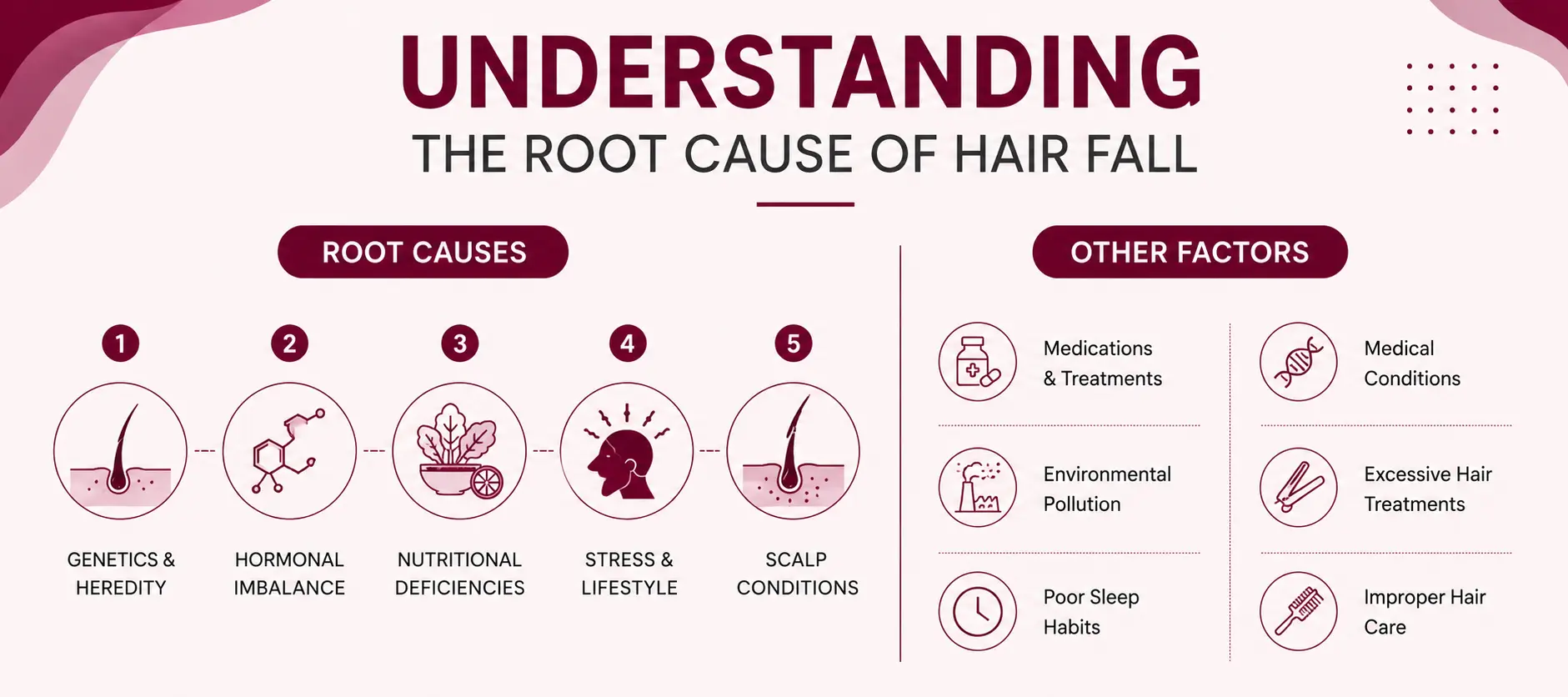
A dermatologist for hair loss can help identify why your hair is shedding, thinning or developing bald patches and recommend an appropriate treatment plan. Hair loss can be associated with hereditary factors, hormonal changes, nutritional deficiencies, illness, medications or scalp conditions. Because different causes require different approaches, a medical assessment is often more useful than trying multiple hair products without understanding the underlying problem.
At Layers Clinics, patients can consult a dermatologist to discuss their hair-loss pattern, medical history, scalp health and suitable next steps. The recommended evaluation and treatment depend on the individual’s symptoms, clinical findings and medical needs.
A consultation becomes particularly important when hair loss is:
Persistent
If excessive shedding continues for several weeks without improvement, professional evaluation can help determine whether the shedding is temporary or associated with an ongoing condition.
Sudden
A sudden increase in shedding can occur after fever, illness, surgery, significant stress, major dietary changes, or certain medications. It can also occur with specific medical conditions.
Patchy
Clearly defined bald patches should not be treated simply as routine hair fall. Conditions such as alopecia areata and certain infections can cause patchy hair loss and require appropriate diagnosis.
Progressive
Gradual thinning that continues month after month may indicate pattern hair loss or another chronic condition. Early assessment can help establish a treatment strategy before thinning becomes more extensive.
Associated With Scalp Symptoms
Hair loss accompanied by persistent itching, scaling, redness, tenderness, burning, or inflammation warrants medical evaluation because scalp disorders can contribute to shedding and hair damage.
Associated With Other Physical Changes
Hair loss occurring alongside menstrual irregularities, significant weight changes, fatigue, changes in body hair, or other symptoms may require evaluation for an underlying medical or hormonal contributor.
Early Signs of Hair Loss You Should Not Ignore
Hair loss does not always begin with obvious bald spots. In many cases, the earliest changes are subtle.
Widening Hair Part
A gradually widening central part can be an early sign of reduced hair density, particularly in women.
Reduced Ponytail Thickness
If the ponytail progressively feels smaller despite maintaining the same hairstyle and length, overall density may have changed.
Increasing Scalp Visibility
A scalp that becomes more visible under normal lighting can indicate thinning, especially around the crown or parting area.
Receding Hairline
Gradual recession around the temples or frontal hairline may occur with androgenetic alopecia.
Excessive Hair Shedding
A noticeable increase in hairs lost during bathing, brushing, or styling can indicate active shedding, particularly when it persists.
Shorter, Finer Hairs
Progressive miniaturisation can cause individual hairs to become finer and shorter over time. This pattern can occur with androgenetic alopecia.
Why Consult a Dermatologist for Hair Fall?
Hair loss is not one condition with one treatment. Different causes require different approaches.
A dermatologist can evaluate the pattern and type of hair loss and distinguish between shedding, follicular miniaturisation, breakage, scalp disease, and other causes.
During an assessment, we may consider:
- Duration of hair loss
- Family history
- Recent illness or fever
- Stress and lifestyle changes
- Dietary patterns
- Medications and supplements
- Hormonal history
- Scalp symptoms
- Hair-care practices
- Pattern of thinning
- Previous hair-loss treatments
Depending on the clinical findings, laboratory investigations may also be considered.
Common Causes of Hair Loss and Hair Thinning
Androgenetic Alopecia
Androgenetic alopecia, commonly called pattern hair loss, is one of the most common causes of progressive hair thinning.
In men, it can present as a receding hairline, thinning at the crown, or progressive loss of density.
In women, widening of the central part and diffuse thinning over the top of the scalp are common patterns.
Because this condition can progress gradually, early assessment may help us establish appropriate long-term management.
Telogen Effluvium
Telogen effluvium is a form of excessive shedding that can occur when more hairs than usual enter the resting phase of the hair cycle.
Possible triggers include:
- Significant illness
- Fever
- Major stress
- Surgery
- Rapid weight loss
- Severe dietary restriction
- Certain medications
- Hormonal changes
The shedding may become noticeable weeks or months after the triggering event.
Identifying and addressing the underlying trigger is an important part of management.
Nutritional Deficiencies
Hair growth requires adequate nutritional support. Depending on the individual, deficiencies involving nutrients such as iron, vitamin B12, vitamin D, protein, or other essential nutrients may contribute to hair problems.
We should avoid taking supplements blindly. Testing and professional guidance can help determine whether a deficiency is actually present and whether supplementation is appropriate.
Hormonal Causes
Hormonal changes can influence hair growth.
Conditions involving the thyroid or other hormonal systems may contribute to hair shedding. In some women, conditions such as polycystic ovary syndrome (PCOS) can be associated with scalp hair thinning.
When hair loss occurs alongside other hormonal symptoms, medical assessment becomes particularly important.
Alopecia Areata
Alopecia areata is an autoimmune condition that can cause sudden, well-defined patches of hair loss.
It can affect the scalp as well as other areas of the body. The pattern and progression can vary considerably, making professional diagnosis important.
Scalp Conditions
Dandruff, seborrheic dermatitis, psoriasis, fungal infections, and other inflammatory scalp disorders can cause symptoms that affect scalp and hair health.
Persistent redness, scaling, itching, burning, or tenderness should be evaluated rather than repeatedly treated with cosmetic products.
Hair Breakage and Damage
Not all apparent hair loss originates from the follicle.
Frequent chemical treatments, excessive heat styling, tight hairstyles, mechanical pulling, and aggressive brushing can cause breakage.
In these situations, reducing damage and addressing the underlying hair-care practices becomes an important part of management.
How a Dermatologist Diagnoses Hair Loss
A proper diagnosis generally begins with a detailed clinical assessment.
We evaluate the distribution of thinning, scalp appearance, hair shaft characteristics, and pattern of shedding.
Depending on the presentation, a dermatologist may use tools such as dermoscopy or trichoscopy to examine the scalp and hair follicles more closely.
Blood tests may be recommended when the medical history or examination suggests a possible nutritional, hormonal, metabolic, or systemic contributor.
The goal is not to order every possible test. Investigations should be selected according to the patient’s symptoms and clinical findings.
What Happens During a Hair-Loss Dermatologist Consultation?
A consultation with a dermatologist for hair fall helps identify possible reasons for persistent hair fall, hair thinning or changes in scalp health. The consultation usually begins with a discussion about your symptoms, medical history and hair-care routine to understand how your hair loss started and whether it has changed over time.
During a hair-loss consultation at Layers Clinics, the assessment may include:
- Reviewing your medical history: The dermatologist may ask about recent illnesses, stress, medication changes, family history and other factors that could contribute to hair loss.
- Assessing the pattern of hair loss: The examination helps identify whether hair thinning affects the hairline, crown, overall scalp or specific patches.
- Examining your scalp: The dermatologist checks for visible signs such as redness, scaling, irritation or other scalp concerns.
- Evaluating the need for investigations: Blood tests or other investigations may be recommended if your symptoms and medical history suggest an underlying cause.
- Discussing suitable treatment options: Depending on the assessment, the dermatologist may explain appropriate medical treatments, scalp care or other options, including PRP when clinically suitable.
- Planning follow-up care: Follow-up appointments may help monitor progress and determine whether the treatment plan needs to be adjusted.
Not everyone experiences hair loss for the same reason, so the evaluation and recommendations can vary from person to person. Consulting a qualified hair loss dermatologist can help you understand the possible cause of your symptoms and make informed decisions about the next steps.
Hair Loss Treatment Options Recommended by Dermatologists
Treatment depends entirely on the diagnosis.
Medical Treatment
Depending on the condition, dermatologists may recommend topical or oral medications to reduce hair loss or support hair growth.
The choice of medication depends on factors such as the type of hair loss, age, sex, medical history, pregnancy considerations where relevant, other medications, and potential side effects.
Medical treatments should be used under appropriate professional guidance.
PRP Therapy for Hair Loss
Platelet-rich plasma (PRP) is a procedure that uses a concentrated component of the patient’s own blood.
After processing a small blood sample, platelet-rich plasma is administered to selected areas of the scalp.
PRP may be considered as part of a treatment plan for certain forms of hair thinning. Results vary between individuals, and it should not be presented as a universal solution for every type of hair loss.
Scalp and Hair-Care Treatments
When scalp inflammation, dandruff, dryness, or other scalp conditions contribute to symptoms, treatment may focus on improving scalp health.
Appropriate scalp care can complement medical treatment and reduce factors that may worsen irritation or hair breakage.
Nutritional Correction
If testing identifies a relevant deficiency, correcting that deficiency may form part of the treatment plan.
We should avoid assuming that hair supplements will solve hair loss. Excessive supplementation can also be inappropriate or harmful in some circumstances.
Can Hair Loss Be Reversed?
Whether hair loss can be reversed depends on the underlying cause and how much the condition has progressed.
Some forms of temporary shedding can improve once the underlying trigger has resolved. Nutritional deficiencies may improve after appropriate correction. Certain inflammatory or autoimmune conditions can also respond to medical treatment.
Pattern hair loss generally requires ongoing management because the underlying tendency to follicular miniaturisation can continue.
The earlier we establish the cause, the more clearly we can determine what type of treatment and long-term management may be appropriate.
How to Choose the Right Doctor for Hair Loss
Choosing the right hair loss doctor is an important step when you experience persistent hair fall, visible thinning or changes in scalp health. A dermatologist with appropriate medical qualifications can assess hair and scalp conditions, investigate possible causes and discuss suitable treatment options.
Before booking a dermatologist consultation for hair loss, consider the following factors:
1. Check Medical Qualifications
Look for a doctor with recognised medical qualifications and relevant training in dermatology. This is important because hair loss may be associated with scalp disorders, hereditary factors, hormonal changes or other medical conditions.
2. Look for Experience With Hair and Scalp Conditions
Choose a dermatologist who regularly evaluates concerns such as excessive hair fall, hair thinning, patchy hair loss and scalp conditions. Relevant experience can help guide the assessment and selection of appropriate treatment options.
3. Understand the Diagnostic Approach
A thorough consultation should consider your symptoms, medical history and hair-loss pattern. Depending on the findings, the doctor may recommend a scalp examination, further investigations or follow-up assessments rather than suggesting the same treatment for everyone.
4. Ask About Treatment Options and Expectations
Before starting treatment, discuss the available options, expected timelines, possible side effects and limitations. A suitable plan should reflect the likely cause of your hair loss, your clinical needs and the doctor’s assessment.
5. Consider Follow-Up and Progress Monitoring
Hair-loss management may require ongoing assessment. Ask how your progress will be monitored and when your treatment plan may need to be reviewed.
At Layers Clinics, Dr. Swathi, Chief Dermatologist, has 14 years of experience in dermatology. A consultation can help assess hair-loss and scalp concerns and discuss appropriate next steps based on individual clinical findings.
If you are experiencing persistent hair fall or progressive hair thinning, consider consulting a qualified dermatologist rather than choosing a treatment based on symptoms alone.
Why Delaying Hair Loss Treatment Can Make Management More Difficult
Progressive hair thinning should not automatically be treated as something that will resolve by itself.
In conditions involving follicular miniaturisation, continued progression can result in increasingly finer hairs and reduced density.
Delaying assessment may also mean that an underlying scalp condition, nutritional issue, hormonal concern, or inflammatory disorder remains unaddressed.
This does not mean that every person with hair shedding requires immediate treatment. It means that persistent, progressive, sudden, or unusual hair loss deserves an appropriate evaluation rather than prolonged guesswork.
Hair Loss Treatment Should Be Personalised
There is no universal hair-loss routine that works for everyone.
Two people may experience similar levels of shedding while having completely different causes.
For example:
- One person may have temporary shedding after an illness.
- Another may have genetic pattern hair loss.
- Someone else may have a nutritional deficiency.
- Another may have a scalp inflammatory condition.
- Some people may have more than one contributing factor.
For this reason, treatment should begin with diagnosis rather than simply selecting a popular hair product or procedure.
Why Choose Layers Clinics for Hair Loss Treatment?
At Layers Clinics, hair loss assessment focuses on understanding the individual rather than treating every case with the same procedure.
Our approach can include:
- Dermatologist-led evaluation
- Assessment of hair-loss patterns
- Scalp and hair examination
- Identification of potential contributing factors
- Personalised treatment planning
- Evidence-based medical treatment where appropriate
- PRP and other selected procedures when suitable
- Scalp-care and lifestyle guidance
- Ongoing monitoring of treatment response
The objective is to move from uncertainty to a clearer understanding of the condition and develop a treatment strategy appropriate for the individual’s needs.
FAQs About Dermatologists for Hair Loss
Which doctor should I consult for hair loss?
A dermatologist is an appropriate doctor to consult for persistent hair loss, visible thinning, bald patches or scalp symptoms. They can assess possible causes and recommend further investigations or treatment when necessary.
When should we see a dermatologist for hair loss?
We should consider a dermatological consultation when hair shedding persists, becomes noticeably heavier, causes visible thinning, appears suddenly or in patches, or occurs with scalp symptoms such as itching, scaling, redness, pain, or inflammation.
What should I ask a dermatologist about hair loss?
Ask about the likely cause of your hair loss, whether investigations are needed, which treatment options are appropriate, possible side effects and how progress will be monitored.
Is losing hair every day normal?
Some daily hair shedding is normal because hairs naturally move through different stages of the growth cycle. A noticeable increase from an individual’s usual shedding pattern, particularly when persistent, should be evaluated.
Can a dermatologist help with excessive hair fall?
Yes. A dermatologist can evaluate the pattern and duration of excessive hair fall, examine the scalp and review relevant medical history. Treatment depends on whether the cause is temporary shedding, hereditary hair loss, a scalp condition or another medical issue.
Can hair loss be reversed?
Some types of hair loss can improve substantially when the underlying cause is identified and treated. Other conditions, including pattern hair loss, may require ongoing management to maintain results and control progression.
Does every person with hair loss need PRP treatment?
No. PRP is one possible option for selected patients, but it is not appropriate for every cause of hair loss. A clinical assessment can help determine whether PRP or another approach is suitable.
Should we take hair supplements for hair loss?
Supplements should not be taken automatically. If a nutritional deficiency is suspected, appropriate evaluation can help determine whether supplementation is necessary and which nutrients need correction.
Can stress cause hair loss?
Significant physical or emotional stress can contribute to temporary excessive shedding in some people. The timing of shedding can occur after the original stressful event, so a dermatologist can help determine whether the pattern is consistent with stress-related shedding or another condition.
Does dandruff cause hair loss?
Scalp conditions such as dandruff and inflammatory disorders can contribute to itching, irritation, scratching, and hair problems. Persistent scalp symptoms should be assessed to determine the underlying condition and appropriate treatment.
Is early treatment important for pattern hair loss?
Pattern hair loss can be progressive. Early evaluation allows the condition to be identified and discussed before thinning becomes more advanced, which can be useful when considering long-term management options. dermatologist for hair loss
key Takeaway
Persistent hair loss, excessive shedding, widening hair part, receding hairline, or visible scalp can indicate the need for professional evaluation. Learn when to see a dermatologist for hair loss, common causes, diagnosis, treatment options, PRP therapy, and personalised hair-loss management.
Conclusion: When Should We See a Dermatologist for Hair Loss?
We should not ignore persistent hair loss until significant thinning or baldness appears. If shedding continues, becomes noticeably different, occurs suddenly or in patches, or is accompanied by scalp symptoms, consulting a dermatologist for hair loss can help identify the cause.
Hair loss may result from genetics, stress, nutritional deficiencies, hormonal changes, scalp conditions, illness, or medications. At Layers Clinics, personalised assessment can help determine suitable treatment options, including medical therapy, PRP, scalp treatment, or nutritional correction.
Early evaluation can provide clarity about the cause and support timely hair-loss management.
Last Updated: Oct 16 2026
