
For men and women experiencing receding hairlines, thinning crowns, pattern baldness, or advanced hair loss, a hair transplant in Vizag can be considered when non-surgical approaches are not providing the desired restoration. At Layers Clinics, we evaluate each patient’s hair-loss pattern, donor hair availability, scalp condition, age, and long-term restoration goals before recommending a treatment approach.
We provide personalized guidance for patients comparing FUE, DHI, FUT, and other hair restoration options. Our treatment planning focuses on creating an appropriate hairline, using available donor follicles efficiently, and achieving coverage that looks consistent with the patient’s existing hair.
Patients considering hair transplantation in Visakhapatnam often want answers about graft requirements, treatment techniques, recovery time, expected growth, maintenance, risks, and hair transplant cost in Vizag. Our consultation process addresses these factors so patients can make an informed decision based on their individual condition rather than choosing a procedure solely on price or promotional claims.
Who Is a Good Candidate for Hair Transplant in Vizag?
Hair transplantation may be considered by men and women experiencing different forms of permanent hair loss. A detailed consultation is important because not every type of hair loss requires surgery.
We commonly evaluate patients experiencing:
- Male pattern baldness
- Female pattern hair thinning
- Receding hairlines
- Crown thinning
- Significant reduction in scalp density
- Advanced baldness
- Hair loss following certain injuries or procedures
- Traction-related hair loss in selected cases
- Patients seeking restoration after unsuccessful non-surgical approaches
The availability and quality of donor hair are particularly important. Transplanted follicles need to come from a suitable donor region, generally from areas of the scalp that demonstrate greater resistance to androgenetic hair loss.
During consultation, we assess whether the expected improvement is realistic and whether transplantation is appropriate for the current stage of hair loss.
Hair Transplant Techniques in Vizag
Different transplantation techniques can be suitable for different patients. We determine the appropriate approach after evaluating the patient’s donor supply and hair-loss characteristics.
1. FUE Hair Transplant
Follicular Unit Extraction (FUE) involves extracting individual follicular units from the donor area using specialized instruments.
The harvested grafts are then prepared and implanted into the recipient region.
FUE is widely used because it does not involve removing a linear strip of scalp. Instead, individual follicular units are extracted, leaving small extraction sites that generally heal over time.
FUE can be considered for:
- Receding hairlines
- Crown restoration
- Moderate hair loss
- Selected cases of advanced baldness
- Patients seeking restoration with minimal visible donor-area scarring
2. DHI Hair Transplant
Direct Hair Implantation (DHI) is an implantation approach in which harvested follicles are placed using an implantation device.
The technique allows the surgeon to control the placement of individual grafts while considering the desired direction, angle, and distribution.
DHI may be considered when precise implantation is particularly important, such as during hairline refinement or density-focused restoration.
3. FUT Hair Transplant
Follicular Unit Transplantation (FUT) involves removing a strip of donor scalp and separating it into individual follicular units for transplantation.
Although FUE has become increasingly popular, FUT can still have a role in selected patients, particularly where a larger number of grafts may be required and the patient’s donor characteristics make the technique appropriate.
4. Body Hair Transplantation
In selected patients with limited scalp donor availability, body hair transplantation (BHT) may be considered. Hair from areas such as the beard or chest can potentially be used as an additional donor source.
However, body hair differs from scalp hair in characteristics such as growth cycle, thickness, and texture. Therefore, BHT requires careful patient selection and realistic expectations.
How We Perform a Hair Transplant in Vizag
A successful procedure begins well before graft extraction.
1. Hair and Scalp Assessment
We examine the extent and pattern of hair loss, donor density, scalp characteristics, existing hair, and the patient’s overall restoration goals.
We also consider whether hair loss is stable or continuing.
2. Treatment Planning
The number of grafts required depends on the area being restored and the desired density. We develop a personalized graft plan rather than using a fixed number for every patient.
3. Hairline Design
Hairline design is one of the most important aspects of a natural-looking transplant.
We consider:
- Facial proportions
- Age
- Existing hairline
- Forehead characteristics
- Hair density
- Future hair-loss possibilities
- Natural irregularities of the hairline
A hairline that is excessively low or perfectly straight may look unnatural. Appropriate irregularity and gradual density transitions can contribute to a more natural appearance.
4. Donor Graft Extraction
Suitable follicular units are carefully extracted from the donor area according to the selected technique.
Graft handling is important because follicles must remain viable before implantation.
5. Graft Preparation
Extracted grafts are examined and prepared for implantation. Careful handling helps minimize unnecessary trauma to the follicular units.
6. Graft Implantation
The prepared grafts are placed into recipient areas according to the predetermined design.
The surgeon considers angle, direction, spacing, density, and existing hair patterns to achieve a natural transition.
7. Post-Procedure Monitoring
After the procedure, we provide specific instructions for washing, medication, physical activity, sleeping position, and scalp care.
Follow-up appointments allow the healing process and subsequent hair growth to be monitored.
Hair Transplant Results Timeline
Hair transplantation requires patience. The transplanted follicles do not immediately produce mature hair.
| Period | What Patients May Experience |
| First few days | Redness, mild swelling, tenderness, and early healing |
| First 1–2 weeks | Grafts stabilize while the scalp continues recovering |
| Weeks 2–8 | Temporary shedding may occur |
| Months 3–4 | Early new hair growth may become noticeable |
| Months 5–6 | Density and coverage gradually improve |
| Months 7–9 | Hair becomes more visible and mature |
| Months 10–12+ | Results continue developing toward their mature appearance |
The exact timeline varies between individuals. Hair growth is influenced by factors such as genetics, age, donor characteristics, existing hair, and overall health.
Benefits of Hair Transplantation in Vizag
A carefully planned hair transplant can offer several advantages for suitable candidates.
Natural-Looking Hair Restoration
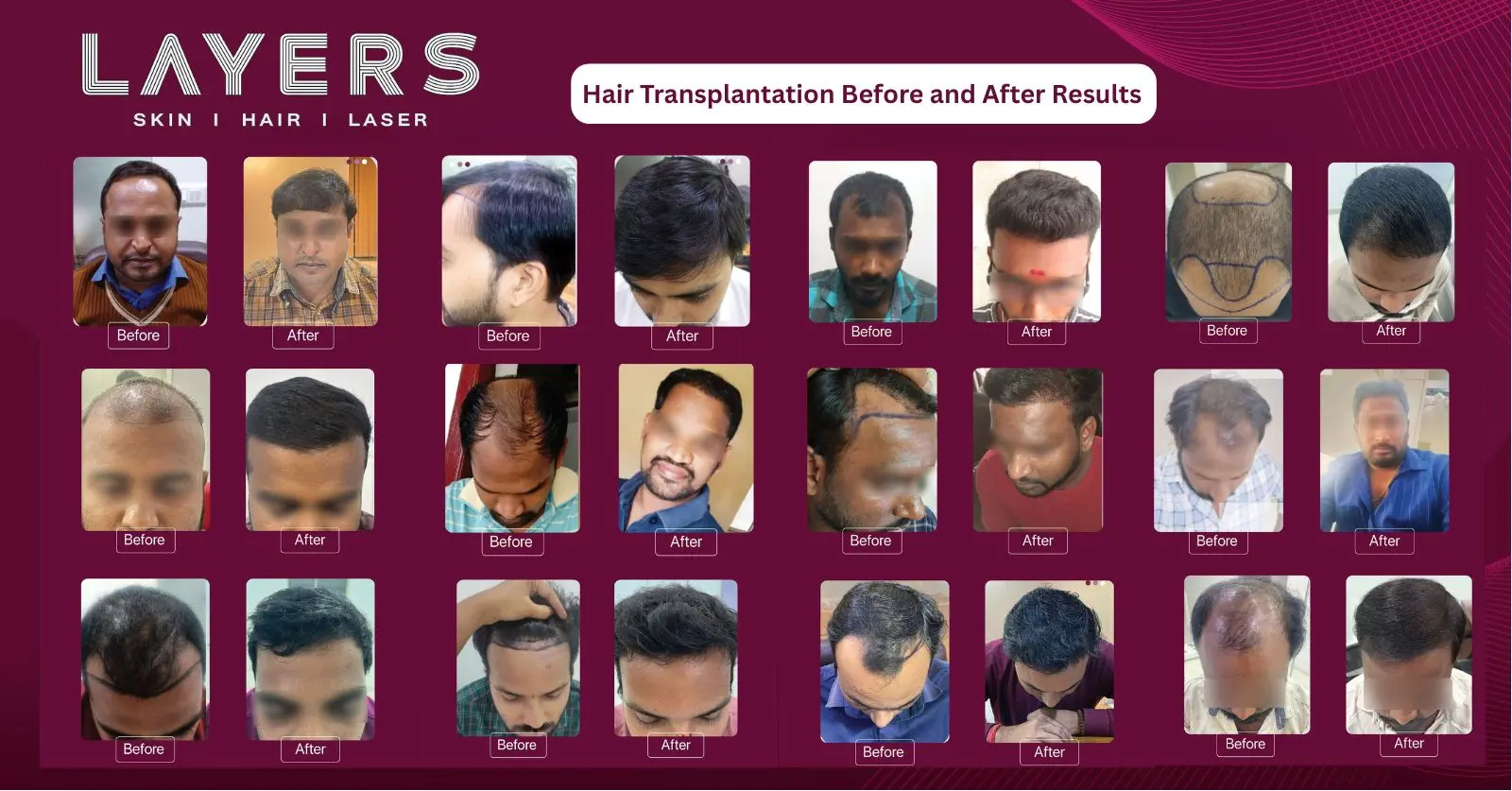
The use of individual follicular units allows hair to be placed according to natural growth patterns. Proper hairline planning is particularly important for achieving an aesthetically balanced result.
Long-Term Hair Restoration
Transplanted follicles from appropriate donor regions can provide long-term hair growth. However, surrounding non-transplanted hair can continue to thin, which is why long-term planning is important.
Improved Hairline Definition
For patients with recession, transplantation can help reconstruct the frontal hairline and improve the overall proportions of the face.
Reduced Dependence on Concealing Products
Patients with significant baldness may become dependent on hairstyles, fibers, sprays, or other cosmetic methods to conceal thinning. Hair restoration can reduce the need for these approaches.
Improved Confidence
Restoring hair density may help patients feel more comfortable with their appearance, hairstyles, photographs, and social interactions.
Hair Transplant Aftercare: What We Recommend
Proper aftercare supports the healing process and protects newly transplanted grafts.
Important instructions may include:
- Follow the prescribed medication schedule.
- Wash the scalp only according to the recommended protocol.
- Avoid scratching or picking at scabs.
- Protect the scalp from unnecessary trauma.
- Avoid strenuous physical activity during the initial recovery period.
- Attend scheduled follow-up appointments.
- Follow the surgeon’s recommendations regarding smoking and alcohol.
- Do not apply unapproved products to the scalp during early recovery.
Individual instructions may differ depending on the procedure and the patient’s condition.
Hair Transplant Cost in Vizag
The cost of hair transplant in Vizag cannot be accurately determined without evaluating the patient’s condition.
Several factors influence treatment pricing:
- Number of grafts required
- Extent of baldness
- Donor hair availability
- Selected transplantation technique
- Complexity of the procedure
- Number of treatment sessions
- Additional treatments recommended by the surgeon
- Clinical and surgical requirements
A patient with mild frontal recession may require significantly fewer grafts than someone with advanced baldness.
At Layers Clinics, we recommend an assessment before finalizing a treatment plan and cost estimate. This allows patients to understand how many grafts are required, which technique is appropriate, what the treatment involves, and what follow-up care is expected.
Hair Transplant vs PRP and GFC Therapy
Hair transplantation, PRP, and GFC are not identical treatments.
PRP (Platelet-Rich Plasma) and GFC (Growth Factor Concentrate) are non-surgical approaches that may be used to support existing hair follicles in suitable patients.
Hair transplantation, on the other hand, involves physically relocating hair follicles to areas requiring restoration.
| Treatment | Primary Purpose |
| Hair Transplant | Restores hair follicles to areas affected by significant hair loss |
| PRP | Supports existing hair and may help improve hair quality in suitable cases |
| GFC | Provides growth-factor-based treatment for selected forms of hair thinning |
In some treatment plans, non-surgical therapies may complement transplantation by supporting existing native hair.
Potential Risks and Considerations
Hair transplantation is a surgical procedure, so patients should understand the potential risks before treatment.
Possible side effects include:
- Temporary swelling
- Redness
- Scalp tenderness
- Temporary numbness
- Temporary shedding
- Infection
- Folliculitis
- Scarring
- Uneven density
- Poor graft growth
- An unnatural hairline in poorly planned procedures
The possibility of complications can be influenced by patient factors, surgical technique, graft handling, and aftercare.
A detailed consultation allows patients to understand both the potential benefits and limitations of treatment.
Why Choose Layers Clinics for Hair Transplant in Vizag?
At Layers Clinics, our approach focuses on individualized planning and natural-looking restoration.
We emphasize:
- Detailed hair and scalp assessment
- Personalized graft planning
- Appropriate technique selection
- Natural hairline design
- Careful follicular-unit handling
- Modern transplantation methods
- Sterile clinical protocols
- Structured post-operative care
- Follow-up monitoring
- Transparent treatment discussions
Our objective is to balance the patient’s expectations with the available donor supply and long-term hair-loss pattern.
Frequently Asked Questions About Hair Transplant in Vizag
Is a hair transplant permanent?
Hair transplantation can provide long-term restoration when suitable donor follicles are transplanted successfully. However, native hair surrounding the transplanted area may continue to experience age-related or genetic hair loss.
Is hair transplantation painful?
The procedure is generally performed under local anesthesia, which minimizes discomfort during surgery. Some patients may experience mild discomfort, tightness, or sensitivity during recovery.
How many grafts do I need?
The required graft count varies according to the extent of baldness, recipient area, donor density, hair characteristics, and desired coverage. A scalp assessment is necessary to determine an appropriate graft plan.
When does transplanted hair start growing?
Early growth commonly becomes noticeable around three to four months, although the timeline varies. Hair density generally continues improving over subsequent months.
How long does a hair transplant procedure take?
The duration depends on the number of grafts and technique used. Larger procedures can take several hours, and the exact duration is determined during treatment planning.
Can women undergo a hair transplant?
Yes. Selected women with suitable patterns of hair loss and adequate donor hair may be candidates. However, female hair loss can have different causes, so appropriate evaluation is essential before considering surgery.
Can advanced baldness be treated?
Advanced baldness may be treatable in selected patients, but the achievable coverage depends heavily on donor hair availability. A realistic treatment plan may prioritize the frontal region and other cosmetically important areas.
Will transplanted hair look natural?
Naturalness depends heavily on hairline design, graft selection, implantation angle, direction, density, and the surgeon’s planning. A properly designed restoration should integrate with the patient’s existing hair rather than appear artificially dense or uniform.
Key Takeaway: Choosing the Right Hair Transplant in Vizag
Choosing a hair transplant in Vizag is a long-term decision that should be based on medical assessment, donor availability, hair-loss progression, treatment goals, and realistic expectations.
Modern techniques such as FUE and DHI can provide effective options for suitable candidates, while FUT and BHT may have roles in selected cases. The technique itself is only one component of successful restoration. Careful diagnosis, hairline planning, graft preservation, precise implantation, and post-operative care are equally important.
At Layers Clinics, we focus on developing personalized treatment plans designed around each patient’s individual hair-loss pattern and donor characteristics. A professional consultation is the first step toward understanding whether transplantation is appropriate and what type of restoration can realistically be achieved.
