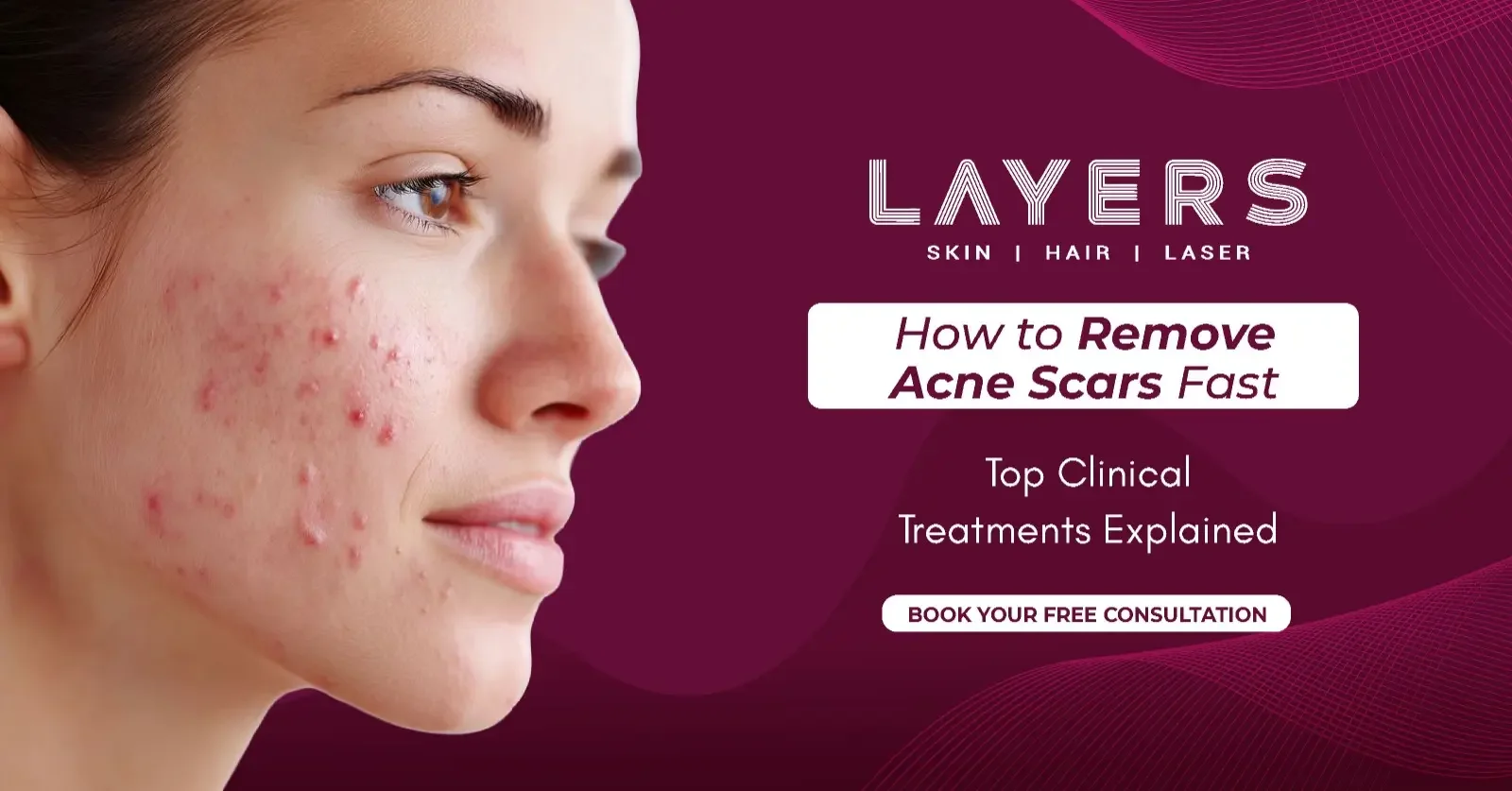
Acne scars can leave uneven skin texture, depressions, and dark marks even after active pimples have healed. If you are wondering how to remove acne scars, the right approach depends on whether you have depressed scars, raised scars, or post-acne pigmentation. Skincare may help fade dark marks, while treatments such as microneedling, fractional laser resurfacing, chemical peels, and subcision may improve selected types of true acne scars.
At Layers Clinics, a dermatologist-led assessment can help identify your scar type and determine which treatment options may suit your skin. Although acne scars cannot always be removed completely, appropriate treatment can reduce their visibility and improve overall skin texture.
What Causes Acne Scars?
Acne scars develop when inflammation from a pimple damages the skin and affects its healing process. The body produces collagen to repair the affected area. If too little or too much collagen forms, a visible scar may develop.
Several factors can increase the likelihood of scarring:
-
Inflamed acne: Deep, painful pimples and cystic acne can damage deeper skin tissue.
-
Picking or squeezing pimples: Manipulating acne can increase inflammation and the risk of scarring.
-
Delayed acne treatment: Persistent inflammatory acne may increase the risk of permanent texture changes.
-
Individual healing response: Genetics and skin repair processes influence scar formation.
It is also important to distinguish acne scars from acne marks. Flat brown, red, or dark spots that remain after a pimple heals are often changes in pigmentation or redness rather than structural scars. These marks may fade gradually, whereas depressed or raised scars usually require a different treatment approach.
How to Remove Acne Scars: Treatment Options Dermatologists Consider
There is no single treatment that works for every acne scar. A dermatologist considers scar shape, depth, skin type, active acne, pigmentation risk, and treatment history before recommending a procedure.
1. Microneedling for Uneven Skin Texture
Microneedling uses fine needles to create controlled micro-injuries that stimulate the skin’s natural repair process and collagen remodeling. It may improve the appearance of selected shallow or rolling acne scars over a series of treatments.
Depending on the assessment, a dermatologist may also consider radiofrequency microneedling, including MNRF, for suitable patients. The procedure, settings, and expected recovery differ according to the device and individual skin condition.
Microneedling is not equally effective for every scar type, and multiple sessions may be needed. Learn more about MNRF treatment.
2. Fractional Laser Resurfacing
Fractional laser resurfacing delivers controlled energy to targeted areas of the skin, encouraging collagen remodeling and improving texture. It may be considered for selected depressed acne scars and uneven skin surfaces.
The choice of laser and treatment settings matters, particularly for Indian skin tones, which may be more susceptible to post-inflammatory hyperpigmentation after irritation or injury. A qualified dermatologist should assess the potential benefits, downtime, and pigmentation risks before treatment.
Improvement is generally gradual, and more than one session may be recommended. Laser treatment cannot guarantee completely scar-free skin.
3. Chemical Peels for Acne Marks and Superficial Concerns
Chemical peels use selected acids to exfoliate the skin and encourage renewal. Depending on the formulation and depth, they may help improve post-acne pigmentation, uneven tone, and certain superficial textural concerns.
Peels are generally more useful for flat acne marks than for deep, tethered scars. The wrong peel or an overly aggressive application can cause irritation and worsen pigmentation, so professional assessment is important.
Explore chemical peel treatment for the face to understand this option.
4. Subcision for Deep or Tethered Acne Scars
Some rolling acne scars appear as depressions because fibrous bands beneath the skin pull the surface downward. Subcision is a procedure in which a trained medical professional releases selected bands beneath the scar.
It may help lift tethered scars and is sometimes combined with microneedling or resurfacing to address different aspects of the scar. Not every depressed scar is suitable for subcision, and the procedure carries risks such as bruising, swelling, and other complications.
5. Dermal Fillers for Selected Depressed Scars
Dermal fillers may temporarily raise certain depressed acne scars by adding volume beneath the skin. They can provide a relatively immediate improvement in appropriately selected cases, but they do not remove the underlying scar tissue.
Results depend on the filler, placement, and individual response. Fillers also carry risks, so they should be administered by an appropriately qualified medical professional after an assessment.
6. Treatment for Raised Acne Scars
Raised scars, including hypertrophic scars and keloids, require a different approach from depressed scars. A dermatologist may consider treatments such as intralesional injections or other scar-directed procedures, depending on the diagnosis.
Laser resurfacing or subcision is not automatically appropriate for raised scars. Identifying the scar type is essential before choosing a treatment.
How to Get Rid of Acne Scars Fast
If you want to know how to get rid of acne scars fast, start by identifying what you are treating. A flat dark mark may respond to an appropriate skincare routine, while a deep, indented scar is unlikely to disappear with a cream alone.
To support improvement:
-
Use a broad-spectrum sunscreen of SPF 30 or higher every day to help prevent dark marks from becoming more noticeable.
-
Choose gentle, non-comedogenic skincare products.
-
Avoid picking, squeezing, or scratching active pimples.
-
Seek professional advice about treatments suited to your scar type.
-
Treat ongoing acne to reduce the risk of new scars.
Some procedures can produce visible changes sooner than others, but collagen remodeling generally takes time. Avoid combining strong exfoliants or home remedies with professional procedures unless your dermatologist approves them.
Does Multani Mitti Remove Acne Scars?
Multani mitti, also called fuller’s earth, is traditionally used in face masks to absorb excess oil. However, there is insufficient strong clinical evidence that it removes established acne scars or reliably treats deep depressions in the skin.
It may leave the skin feeling temporarily less oily, but that is not the same as repairing scar tissue. If a dark mark is caused by pigmentation, improvement requires a suitable approach to pigmentation and sun protection. If it is a true depressed scar, a dermatologist may recommend a procedure instead.
Multani mitti can also dry or irritate sensitive skin. Irritation may worsen post-inflammatory pigmentation in susceptible individuals. Avoid harsh scrubbing and discontinue any product that causes burning, redness, or discomfort.
How to Get Rid of Acne Marks on the Face
Flat marks left after acne often improve differently from scars. Depending on the cause and skin sensitivity, a dermatologist may recommend ingredients such as azelaic acid, niacinamide, or a retinoid. Some ingredients are unsuitable during pregnancy, and retinoids can irritate the skin, so seek professional guidance when needed.
Daily sunscreen is important because ultraviolet exposure can darken pigmentation and delay its fading. Avoid using multiple strong active ingredients at once, and do not apply bleaching products or unprescribed steroid creams to acne marks.
If you are still developing pimples, treating active acne is equally important. A suitable acne treatment plan can help prevent new marks and scars from forming.
How Many Sessions Are Needed, and When Will You See Results?
The number of sessions depends on the scar type, depth, procedure, healing response, and whether combination treatment is needed. Some patients notice early improvement after an initial procedure, while others require several sessions and a longer period for collagen remodeling.
Pigmentation may take weeks or months to fade, while deeper scars can require a more extended treatment plan. Your dermatologist should explain expected improvement, recovery time, risks, and the likely number of sessions before treatment begins.
No clinic can responsibly guarantee complete scar removal or a fixed result within a specific number of sessions.
Why Choose Layers Clinics for Acne Scar Treatment?
Choosing a treatment starts with an accurate skin assessment. At Layers Clinics, patients can discuss their acne scar concerns with the clinical team and explore suitable options based on their skin condition and goals.
A personalized plan may consider:
-
The type, depth, and distribution of acne scars.
-
Whether active acne or pigmentation also needs treatment.
-
Which procedures may be appropriate for the patient’s skin.
-
Possible side effects, recovery time, and treatment costs.
-
Follow-up appointments to monitor progress and adjust the plan.
If you are looking for acne scar treatment, arrange a consultation to discuss your concerns and treatment options. You can also explore scar reduction treatments. Patients seeking care in Hyderabad can review the dermatologist options for acne scar treatment in Hyderabad.
Frequently Asked Questions
1. How do I remove acne scars?
Treatment depends on the scar type. Microneedling, fractional laser resurfacing, subcision, and selected chemical peels may help improve different scars. A dermatologist can identify the most appropriate option.
2. How can I reduce acne scars naturally?
Use gentle skincare, wear sunscreen, avoid picking pimples, and keep active acne under control. These steps can support skin health and help prevent further marks, but they generally cannot eliminate established deep scars.
3. Does Multani mitti remove acne scars?
There is insufficient strong clinical evidence that Multani mitti removes acne scars. It may absorb excess oil temporarily, but it does not reliably repair depressed scar tissue.
4. How do I get rid of deep acne scars?
Deep or tethered scars may require procedures such as subcision, fractional resurfacing, or other scar-specific treatments. The appropriate choice depends on the scar’s structure and your skin.
5. How can I get rid of acne scars fast?
There is no universally fastest treatment. Some options offer earlier visible improvement, but most scar treatments work progressively and may require multiple sessions.
6. Can acne scars be removed permanently?
Complete removal cannot be guaranteed. Professional treatments can reduce scar visibility, but results vary and some scars may remain visible. Maintenance and prevention of new acne may also be necessary.
7. How can I remove acne and acne marks together?
A dermatologist may create a plan that treats active acne, flat pigmentation, and structural scars separately. Combining treatments can be useful, but procedures and skincare products should be selected carefully to avoid irritation.
8. When should I see a dermatologist for acne scars?
Seek an assessment if you have persistent deep acne, new scars, painful breakouts, or marks that are not improving. Early acne management can help reduce the risk of additional scarring.
Final Takeaway
The best way to address acne scars is to identify whether you have depressed scars, raised scars, or flat post-acne marks. Skincare and sunscreen can support recovery and help prevent further pigmentation, while dermatologist-selected procedures may improve established scars. At Layers Clinics, a personalized assessment can help you understand suitable options, expected recovery, and realistic results.