
Black and dark ink
Black and dark-blue inks often respond more readily. Dense professional tattoos, cover-ups and deep pigment may still require a long course.
Whether you want to fade a design for a cover-up or explore removal, start with the ink, your skin and a realistic plan.
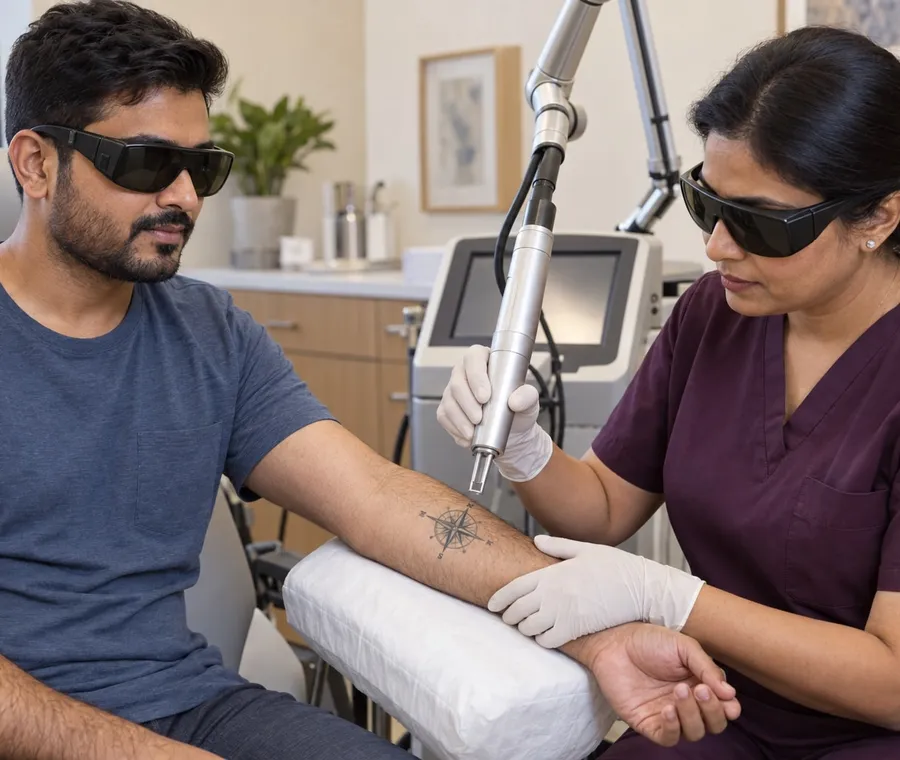
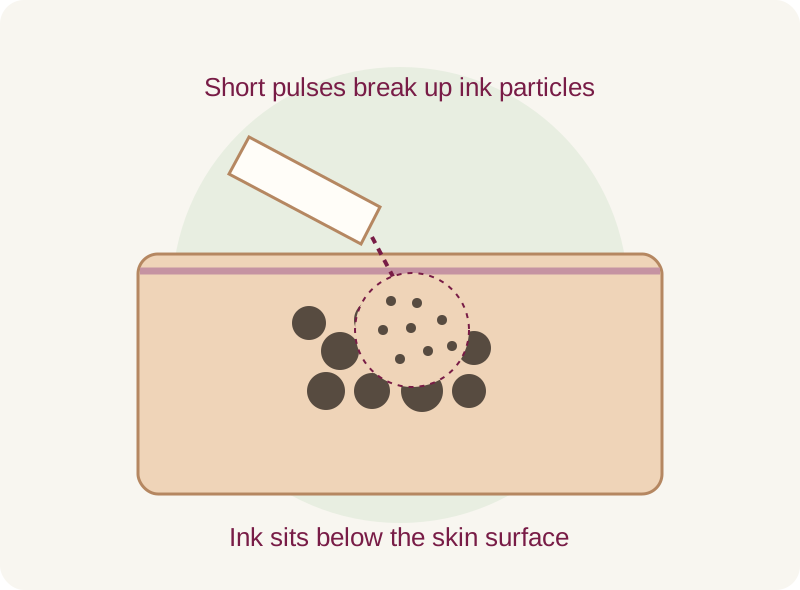
Tattoo ink sits beneath the skin’s surface. Short laser pulses break selected pigment into smaller particles, which the body gradually clears over time.
Different colours absorb different wavelengths. Tattoo size, ink density, layering, skin tone and previous treatment all influence how much fading may be possible.
Black and dark-blue inks often respond more readily. Dense professional tattoos, cover-ups and deep pigment may still require a long course.

Different colours may need different wavelengths, and some can resist fading. Tell the clinician about any cover-up layers or earlier removal.
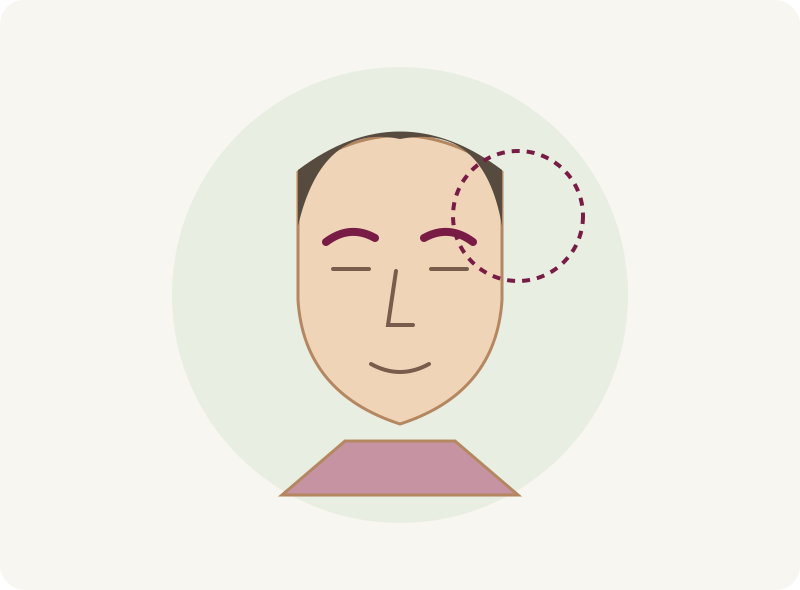
Permanent makeup and pale inks need specialist assessment. Some pigments can darken with laser; the eye area needs specific protection.
Partial fading for a future cover-up and fuller removal are different goals. Agree what would be useful to you before starting.
Mention itching, raised skin, allergy, scarring or previous burns. Active reactions or an uncertain skin lesion need assessment before routine removal.
Discuss medicines, tanning, pregnancy and any history of poor wound healing. Leave room in your schedule for recovery and repeat visits.
The clinician checks colour, size, layering, skin tone and previous treatment. Photographs may record the starting point.
Discuss a suitable laser, test-area needs, comfort measures and likely limits. Equipment availability should be confirmed at your clinic.
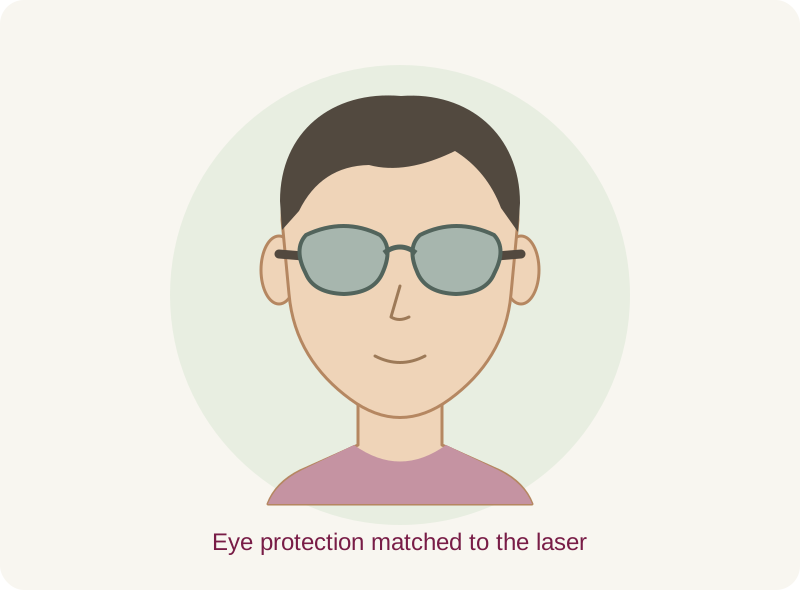
The skin is cleaned, appropriate eye protection is used and the agreed pain relief is provided.
The clinician delivers controlled pulses and monitors the skin. Temporary whitening or frosting can appear; it is not the final clearance result.
Follow the dressing, cleansing and ointment instructions. Do not pick crusts or puncture blisters.
The skin needs time to recover and clear pigment. Further sessions depend on healing and actual fading.
Repeated sessions with healing intervals are usually needed. A fixed promise based only on a photograph cannot account for all the ink and skin factors.
Some tattoos fade substantially; others leave resistant colour or a faint outline. Existing texture or scarring from the tattoo may remain. Complete clearance and scar-free skin cannot be guaranteed.
Compare progress and skin recovery before each further session. Slower fading may call for a new plan or a decision to stop.
If your goal is a new design, discuss the required fading and allow the skin to heal fully before tattooing again.
Redness, swelling, tenderness, blisters or crusting can occur. Keep to the recommended cleaning and dressing routine and avoid friction.
Ask when to resume swimming, vigorous exercise and active skin products. Cover exposed healing skin; use sunscreen as advised once the surface is suitable.
Increasing pain, spreading redness, discharge or persistent pigment changes need review. Infection, darker or lighter patches and scarring are possible.
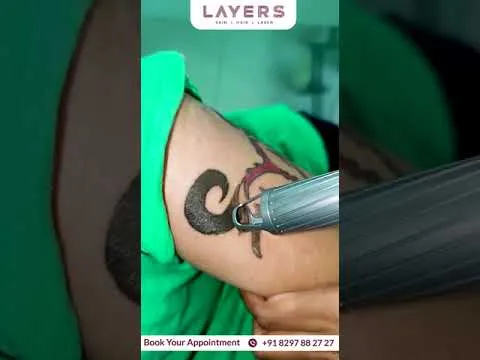
A short treatment demonstration from the Layers channel. Whitening during a pulse is an immediate skin response, not proof that the tattoo has fully cleared.
Layers Skin & Hair Clinics · Treatment demonstration
Watch on YouTubeVerified Google review excerpts about consultations at Layers. The condition is not specified; these are not tattoo-removal results.
“The doctors listened carefully to my concerns and explained the treatment in a clear and professional manner.”
Consultation experience; condition not specified.
“She explained the treatment clearly and made me feel comfortable throughout the consultation.”
Consultation experience; condition not specified.
“The doctor took the time to understand my skin concerns and explained the treatment plan clearly, without rushing.”
Consultation experience; condition not specified.
“Very patient ,humble and polite to answer every single query and build confidence.”
Consultation experience; condition not specified.
“The doctors explained everything clearly and made me feel comfortable and confident.”
Consultation experience; condition not specified.
“The doctor took the time to listen to my concerns patiently and explained the treatment options clearly.”
Consultation experience; condition not specified.
















No. Ink colour, depth, layering and skin response can limit clearance. A residual outline or some colour may remain even after several sessions.
A course is usually needed, but the number and spacing depend on assessment and response. Allow healing time between sessions rather than trying to rush the process.
Both can deliver short pulses to target ink; picosecond pulses are shorter. Wavelength, ink and skin matter as well as pulse duration. A device label alone does not guarantee fewer sessions or full removal.
Laser pulses can be uncomfortable. Your clinician can discuss cooling or suitable anaesthetic, and the area may remain sore afterwards.
Scarring is possible, as are darker or lighter patches. An existing tattoo scar may become more apparent as ink fades. Careful treatment and aftercare help reduce risk.
Some can be treated, but certain cosmetic inks darken with laser and may be difficult to clear. The eye area requires a specialist plan and protection.
Selected-area fading may be possible. Discuss the boundaries and your goal before treatment, especially if you plan a cover-up.
They do not reliably reach ink in the deeper skin and can cause burns or scars. Avoid trying to scrape, burn or chemically remove a tattoo at home.
Get a clear plan for your tattoo, your skin and your next step.
Prefer a call? +91 9000 572727