
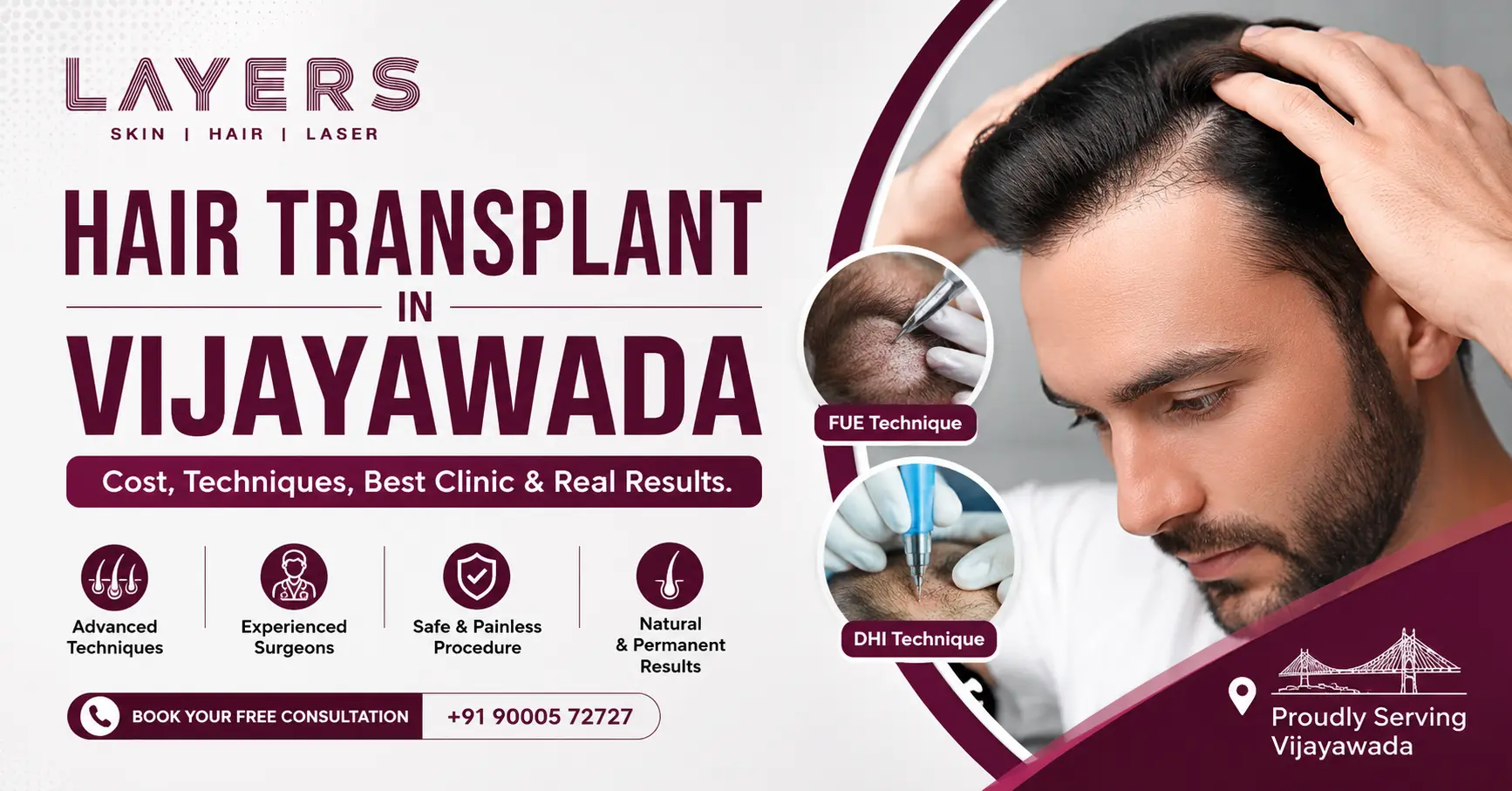
A hair transplant in Vijayawada is a permanent solution for hair loss with 90–95% graft survival rates when performed by experienced surgeons. Most patients need 1 session (2,000–4,000 grafts), with visible results starting at 3–4 months and full growth by 10–12 months. The right technique (FUE, DHI, FUT) and surgeon expertise directly impact your final results.
What Is Hair Transplant Surgery?
A hair transplant is a minimally invasive surgical procedure where healthy, DHT-resistant hair follicles are moved from the donor area (back/sides of scalp) to bald or thinning areas.
Why it works permanently: Hair follicles from the donor zone are genetically resistant to hair loss. Once transplanted, they continue growing for life, making this the only long-term solution, not just a temporary fix.
Hair Loss Grades: Which Stage Are You?
Your hair loss stage determines the right technique, graft count, and cost so identifying it comes first.
Norwood Scale (Men)
| Grade | Description | Recommended Treatment |
| 1 | No visible loss, slight recession | PRP + medications |
| 2 | Mild recession at temples | PRP, medications, early FUE |
| 3 | Noticeable temple recession | FUE (1,500–2,000 grafts) |
| 4 | Significant crown + temple loss | FUE (2,500–3,000 grafts) |
| 5 | Large bald area, top of scalp | FUE (3,000–4,000 grafts) |
| 6 | Top of scalp mostly bald | FUE + DHI (3,500–5,000 grafts) |
| 7 | Severe baldness, thin donor area | Multiple sessions / BHT |
Ludwig Scale (Women)
| Grade | Description | Recommended Treatment |
| 1 | Mild thinning, wide part | PRP + medications |
| 2 | Moderate thinning, wider part | FUE (1,500–2,500 grafts) |
| 3 | Severe thinning, visible scalp | FUE + PRP combination |
A free consultation at Layers Clinics includes a trichoscopy analysis that precisely maps your hair loss and donor density before recommending a technique.
Hair Transplant Techniques in Vijayawada at Layers Clinics
1. FUE — Follicular Unit Extraction
The most widely used technique worldwide. Individual follicular units (1–4 hairs each) are extracted using a motorized punch tool under local anesthesia, then placed one by one into natural-angle recipient sites.
Why patients choose FUE: no linear scar (tiny dot scars, invisible once hair grows), faster recovery (5–7 days), can wear hair short after healing, suitable for most grades (2–6).
Best for: Grade 2–6 hair loss, patients who wear hair short, minimal scarring priority
2. DHI — Direct Hair Implantation
DHI uses a specialized implanter pen to place grafts directly, without pre-made recipient sites allowing denser, more precise placement in targeted zones.
Why patients choose DHI: highest graft survival rate (93–95%), better density in targeted areas like the crown or hairline, less scalp trauma, more natural hairline design.
Best for: Grade 3–5 with specific area targeting (crown or hairline density)
3. FUT — Follicular Unit Transplantation
A strip of scalp is removed from the donor area, dissected into individual grafts, and transplanted then the donor strip is stitched closed.
Why FUT is preferred in some cases: highest graft yield per session, lower cost per graft, better suited to fine/low-density donor hair, single-session maximum coverage.
Consideration: leaves a thin linear scar at the donor site (concealed by surrounding hair) — not ideal for patients who want to shave their head.
Best for: Grade 6–7 needing maximum grafts, patients with good scalp laxity
4. BHT — Body Hair Transplant
Uses hair from the chest, beard, arms, or legs as a supplemental donor source when scalp donor hair is insufficient often combined with scalp FUE.
Consideration: body hair has a different growth cycle and texture; blend results vary, so surgeon experience matters more here than with any other technique.
Best for: Advanced hair loss, repair cases, limited scalp donor area
Technique Comparison
| Factor | FUE | DHI | FUT | BHT |
| Scarring | Minimal (dots) | Minimal (dots) | Thin linear scar | Minimal body dots |
| Graft survival | 90–92% | 93–95% | 88–92% | 85–90% |
| Recovery time | 5–7 days | 5–7 days | 10–14 days | 7–10 days |
| Grafts per session | 2,000–4,000 | 1,500–3,000 | 3,000–5,000 | 500–2,000 |
| Best for grade | 2–6 | 3–5 | 5–7 | 6–7 |
| Can wear hair short | Yes | Yes | No | Yes |
Hair Transplant Cost in Vijayawada
Total cost = Grafts needed × Rate per graft.
What affects your total cost:
- Graft count — the single biggest factor, determined by hair loss grade, desired density, and scalp laxity; confirmed precisely only via in-person trichoscopy
- Technique chosen — FUT is cheapest per graft; DHI costs more but has the highest survival rate
- Surgeon experience — cost reflects surgical expertise, not just clinic overhead
- Clinic technology — FDA-approved motorized extraction tools and microscope-assisted graft preparation affect precision and price
- Session count — Grade 1–5 usually needs one session; Grade 6–7 may require two
Results: What to Realistically Expect
| Timeframe | What Happens |
| Day 1–3 | Transplanted hair visible; mild swelling/redness; scabs forming |
| Week 1–2 | Scabs falling off; follow-up visit; mild itching (normal healing) |
| Week 2–4 | Shock loss — transplanted hair falls out; this is normal and expected, not failure |
| Month 2–3 | First fine, light new hair emerges; donor area fully healed |
| Month 4–6 | Noticeable thickening and darkening; most patients see clear results by month 5 |
| Month 8–10 | 70–80% of final density achieved; hairline fully formed |
| Month 12 | Full results visible; 90–95% of grafts growing; results are permanent from this point |
Important: Hair shedding after transplant is normal, not failure.
Risks & Safety (What You Should Know)
Hair transplant is safe, but like any procedure:
- Temporary swelling or redness
- Shock loss (expected phase)
- Minor discomfort
- Rare infection (if aftercare ignored)
- Poor results if done by inexperienced clinics
Smoking can reduce graft survival by 30–40%.
Who Is the Right Candidate?
Good candidates:
- Men aged 22–65 with stable (not rapidly progressing) hair loss
- Women with female pattern baldness or hairline recession
- Anyone with adequate donor hair density (assessed during consultation)
- Patients with realistic expectations improvement, not a return to teenage density
Who should wait or consider alternatives:
- Under 22 — hair loss may still be actively progressing; consult first
- Rapidly progressing hair loss stabilize with medication before surgery
- Insufficient donor area BHT may be assessed as an option
- Uncontrolled medical conditions (diabetes, bleeding disorders) medical clearance required first
- Pregnant or nursing women should wait until after
Before & After Care Guidelines
Before Surgery:
- Stop smoking & alcohol (2–4 weeks)
- Avoid blood thinners
- Complete basic medical tests
After Surgery:
First 3 Days:
- No touching grafts
- Use saline spray
- Sleep at 45° angle
First 2 Weeks:
- Gentle washing
- Avoid sweating/gym
After 1 Month:
- Resume normal lifestyle
- Consider PRP for better results
Hair Transplant for Women in Vijayawada
Women account for roughly 25–30% of hair transplant patients, and results can look especially natural due to longer baseline hair length.
How female pattern hair loss differs: women typically experience diffuse thinning across the entire scalp rather than patchy baldness showing up as a widening part line and reduced overall density, with hairline recession being less common than in men.
Hair Transplant vs. Other Hair Loss Treatments
| Treatment | Permanence | Effectiveness |
| Hair transplant (FUE/DHI) | Permanent | Excellent |
| PRP therapy | Temporary | Good (early-stage loss) |
| Minoxidil (topical) | Temporary | Moderate |
| Finasteride (oral) | Temporary | Good (men) |
| Scalp micropigmentation | Semi-permanent | Aesthetic only |
| Hair patch/wig | Temporary | Cosmetic |
Why Choose Layers Clinics in Vijayawada?
- OMFS-certified surgeons with technique-specific experience across FUE, DHI, FUT, and BHT
- FDA-approved equipment, including motorized extraction tools and microscope-assisted graft preparation
- Transparent pricing — a full cost breakdown before the procedure, no hidden charges
- Comprehensive aftercare, from the first 72 hours through annual checkups
- Dedicated hair restoration team, not a general cosmetic practice treating hair as an add-on
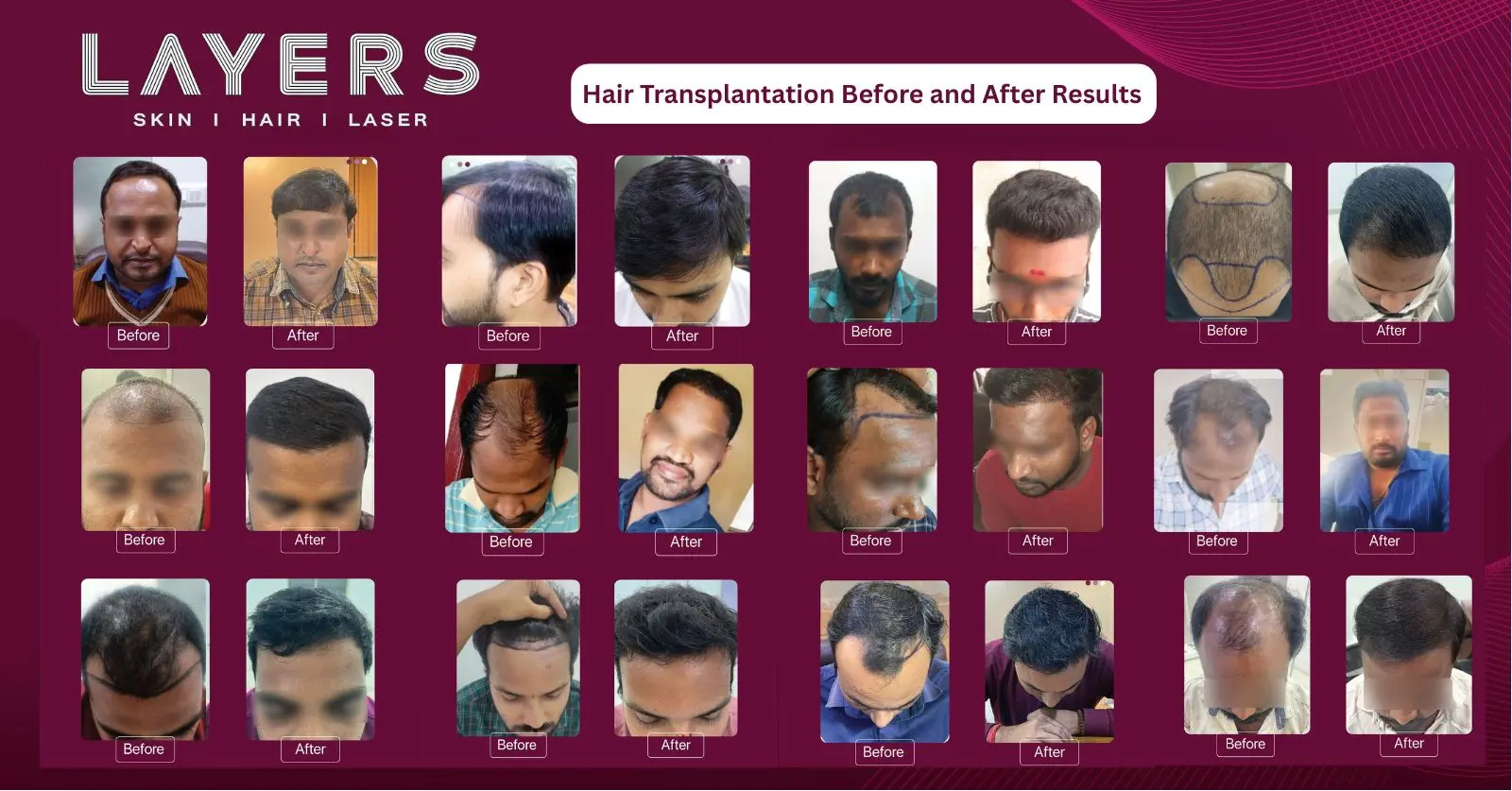
Real Patient Insight
Patients in Vijayawada typically see:
- Noticeable hairline improvement by Month 5
- Natural density by Month 8–10
- Permanent growth after 1 year
Consistent follow-ups and proper aftercare significantly improve outcomes.
FAQ: Hair Transplant in Vijayawada
Is hair transplant painful?
No. It’s performed under local anesthesia, so patients feel little to no pain during the procedure. Mild discomfort afterward usually improves within 2–3 days.
Can I style or color transplanted hair?
Yes. Once transplanted hair fully grows in, it can be cut, styled, and coloured like your natural hair.
What is the success rate of hair transplant?
When performed by experienced surgeons, graft survival rates typically fall in the 90–95% range, varying slightly by technique.
How is DHI different from FUE?
Both use the same extraction method, but DHI implants grafts directly with a specialized pen for higher precision and survival rate, while FUE creates recipient sites first DHI is often chosen for maximum density in the crown or hairline specifically.
Do I need to stay in Vijayawada after the procedure, or can I travel?
Most patients return home the same day and don’t need an outstation stay. Short-distance travel (within the city) the next day is generally fine; longer travel should wait until your surgeon confirms healing is on track.
Key Takeaway
If you’re experiencing hair loss, delaying treatment can reduce available donor hair. A hair transplant in Vijayawada offers a safe, permanent, and natural-looking solution when done correctly.
The key is choosing the right clinic, right technique, and right timing.
Take the Next Step
- Identify your hair loss grade
- Calculate graft requirement
- Get a personalized treatment plan
Early action = better density + better long-term results.
Exact Location On Google Maps:
Clinic Address
D.No: 54, Sree Nivas, 2nd Floor, Service Rd, near Novotel Hotel, Bharathi Nagar, Vijayawada, Andhra Pradesh 520008.
