
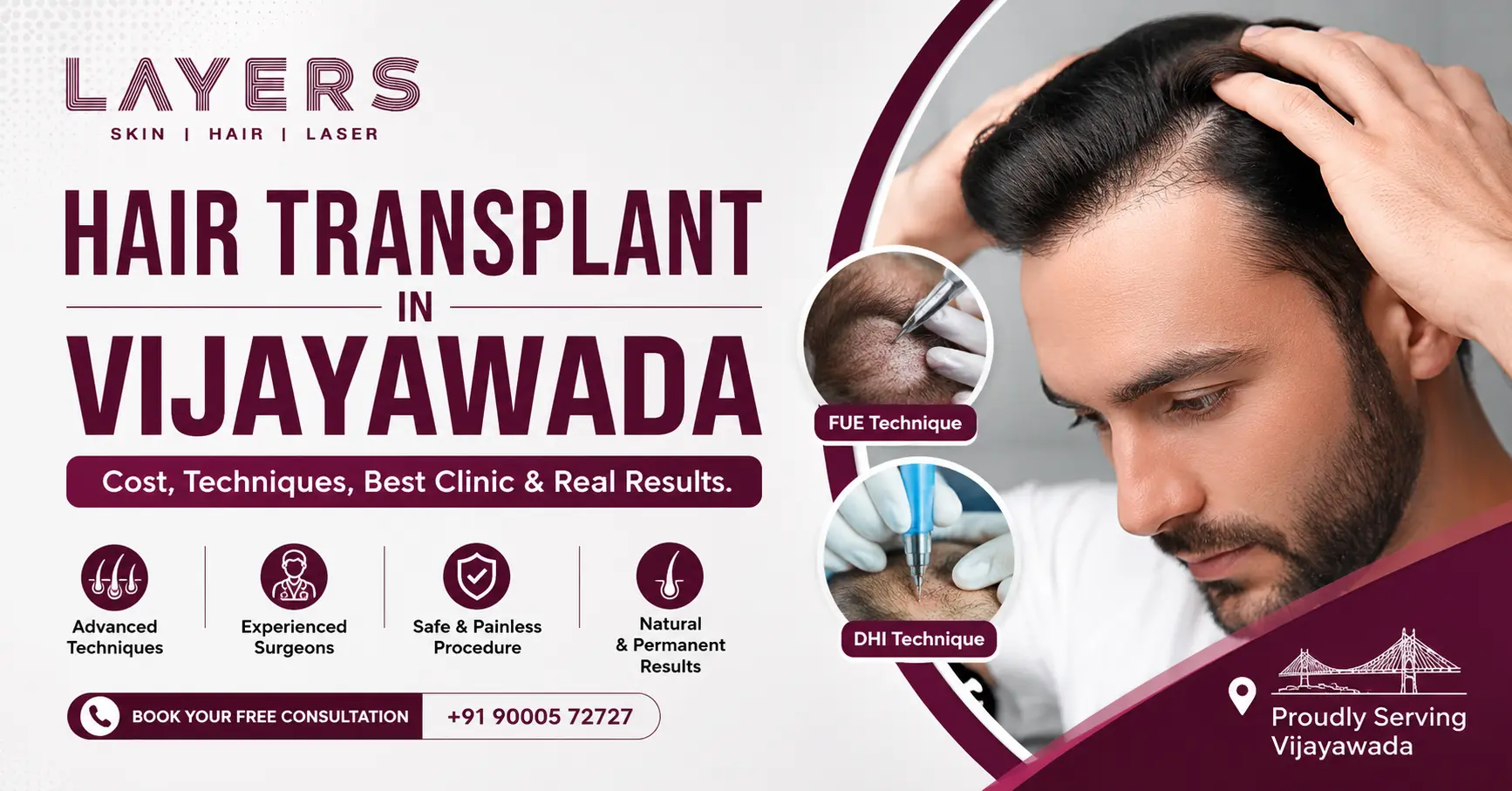
Hair loss can affect appearance, confidence, and the way we feel about ourselves. When hair thinning progresses despite conventional treatments, hair transplant in Vijayawada can provide a long-term option for restoring hair in areas where density has been lost.
At Layers Clinics, we approach hair restoration as an individualized surgical procedure rather than a one-size-fits-all treatment. We assess the pattern of hair loss, donor hair density, hair calibre, scalp condition, age, family history, and future hair-loss risk before recommending a treatment plan.
A successful hair transplant is not simply about placing the maximum number of grafts. Our objective is to use the available donor hair efficiently and create a natural-looking hairline, appropriate density, balanced coverage, and long-term aesthetic result.
Hair Loss Assessment: Why Diagnosis Comes First
Before considering surgery, we determine the cause and pattern of hair loss.
Common causes include:
- Androgenetic alopecia
- Pattern hair loss
- Certain inflammatory scalp conditions
- Nutritional deficiencies
- Hormonal factors
- Temporary shedding conditions
- Previous surgical or traumatic hair loss
Not every type of hair loss requires transplantation. Some patients may benefit more from medical management or a combination of treatments.
During consultation, we assess the scalp and donor region and evaluate the progression of hair loss. Detailed donor assessment is particularly important because overharvesting can compromise the appearance of the donor area and limit future treatment options. Indian hair-transplant practice guidelines emphasize evaluating donor density, hair calibre, hair characteristics, and the safe donor area before surgery.
Hair Transplant Techniques in Vijayawada
We select the transplantation technique according to the patient’s anatomy, donor supply, degree of hair loss, desired result, and surgical requirements.
1. FUE Hair Transplant in Vijayawada
Follicular Unit Excision (FUE) involves harvesting individual follicular units from the donor area using small punches.
The extracted grafts are then prepared and implanted into the recipient area.
Advantages of FUE
- Individual graft extraction
- No long linear donor scar
- Suitable for many patients who prefer shorter hairstyles
- Allows selective harvesting
- Can be used for hairline, mid-scalp, and crown restoration
- Generally involves a relatively straightforward recovery compared with strip surgery
FUE requires careful planning and harvesting. Poor technique or excessive extraction can cause visible donor depletion, which is why donor-area management is an important part of the procedure.
2. DHI Hair Transplant
Direct Hair Implantation (DHI) generally refers to implantation using an implanter device after follicular units have been harvested.
The technique can provide the surgeon with controlled placement of grafts and may be useful in selected cases where precise implantation is required.
However, we do not consider DHI automatically superior to every other transplant technique. The best approach depends on the individual patient’s donor and recipient characteristics.
The skill of the surgical team, graft handling, recipient-site planning, hairline design, and overall treatment strategy remain important regardless of the implantation instrument used.
3. FUT Hair Transplant
Follicular Unit Transplantation (FUT) involves removing a strip of donor scalp and dissecting it into individual follicular units for transplantation.
FUT can be useful in selected patients who require a substantial number of grafts and have suitable donor characteristics.
The principal consideration is that FUT leaves a linear donor scar, unlike the small individual extraction sites associated with FUE.
Consequently, the choice between FUE and FUT should be made after evaluating the patient’s donor characteristics, hairstyle preferences, degree of hair loss, and long-term restoration requirements.
4. Body Hair Transplant
In selected advanced cases, hair from areas such as the beard or chest may be considered as an additional donor source.
However, body hair is not identical to scalp hair. Its growth cycle, thickness, texture, and growth characteristics can differ considerably.
For that reason, we consider body hair transplantation a specialized option, rather than a standard replacement for adequate scalp donor hair.
FUE vs DHI vs FUT: Which Hair Transplant Technique Is Best?
| Factor | FUE | DHI | FUT |
| Harvesting | Individual follicular units | Individual follicular units | Donor strip |
| Donor scar | Small extraction marks | Small extraction marks | Linear scar |
| Short hairstyles | Generally suitable | Generally suitable | Requires consideration of linear scar |
| Large graft requirements | Suitable in selected cases | Depends on case | Can be useful in selected cases |
| Recovery | Individualized | Individualized | Usually longer than FUE |
| Best technique | Depends on patient | Depends on patient | Depends on patient |
There is no universally best technique for every patient. Published practice guidance also emphasizes that technique selection should be individualized according to the patient’s characteristics and the surgeon’s clinical judgment.
Hair Transplant Cost in Vijayawada
One of the most searched questions is: “How much does a hair transplant cost in Vijayawada?”
There is no medically responsible single price that applies to every patient.
The total cost depends on:
- Number of grafts required
- Hair-loss pattern
- Donor-area density
- Selected surgical technique
- Complexity of the procedure
- Surgeon’s expertise
- Number of sessions required
- Pre-operative assessment
- Post-operative follow-up and care
A patient with mild temple recession may require considerably fewer grafts than someone with extensive frontal and crown hair loss.
Therefore, we recommend obtaining a personalized graft assessment and treatment plan rather than comparing clinics solely on a quoted per-graft price.
A lower price does not necessarily represent better value if excessive harvesting, poor hairline planning, inadequate graft handling, or insufficient follow-up compromises the final result.
How Many Grafts Do We Need for a Hair Transplant?
The number of grafts varies substantially between patients.
We consider:
- Frontal hairline recession
- Frontal forelock density
- Mid-scalp thinning
- Crown involvement
- Donor density
- Hair calibre
- Existing native hair
- Desired cosmetic density
- Future progression of hair loss
Importantly, more grafts do not automatically mean a better result.
The goal is to achieve the best possible cosmetic improvement while protecting the donor area for the future.
Hair-transplant guidelines specifically emphasize safe donor-area assessment and avoiding excessive harvesting.
Hair Transplant Results: What Should We Expect?
Hair transplantation is not an overnight transformation.
Immediately after surgery, the transplanted grafts are visible, while the scalp may show redness, swelling, or small crusts during the early healing period.
During the following weeks, transplanted hairs may shed. This can be part of the normal hair-transplant growth cycle and does not necessarily mean that the procedure has failed. The American Society of Plastic Surgeons notes that transplanted hair can temporarily fall out before new growth resumes.
New growth develops gradually.
Typical Hair Transplant Timeline
| Period | What We May Observe |
| First few days | Redness, swelling, tenderness and early healing |
| First 1–2 weeks | Crusting reduces and grafts stabilize |
| Following weeks | Temporary shedding may occur |
| Around 3–4 months | Early new growth may become noticeable |
| Around 5–8 months | Increasing density and hair calibre |
| Around 9–12 months | Significant maturation of the result |
| Beyond 12 months | Further maturation may continue depending on the patient |
The exact timeline varies from person to person.
We therefore avoid promising an identical result or a fixed percentage of growth for every patient.
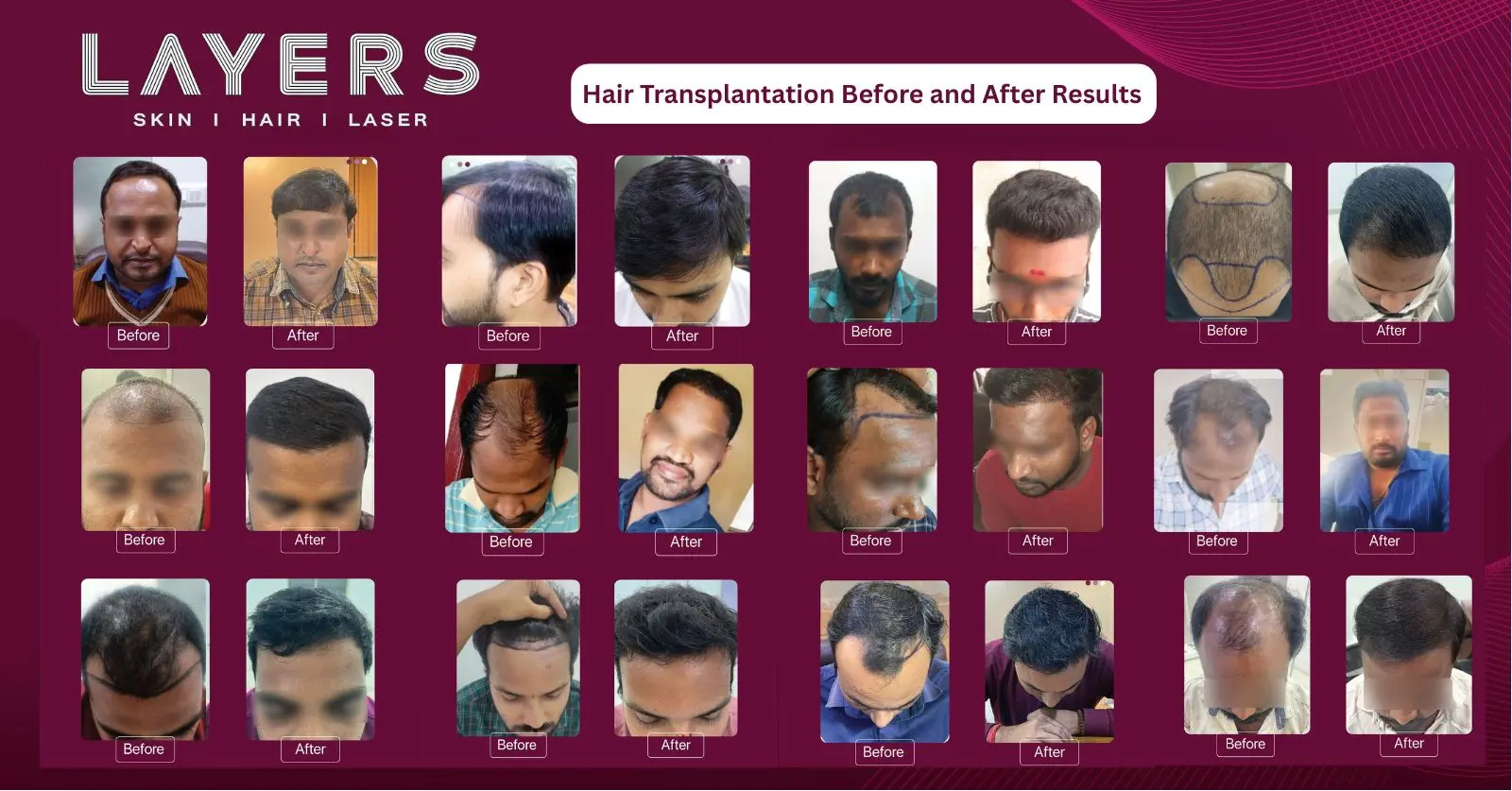
Is Hair Transplant Permanent?
Transplanted follicles are selected from donor regions that are relatively resistant to androgen-related hair loss.
However, “permanent” should not be interpreted as meaning that every existing hair on the scalp will remain unchanged forever.
A transplant does not stop the progression of native, non-transplanted hair.
For example, a patient may restore the frontal hairline with transplanted follicles while the surrounding native hair continues to thin over time.
This is why long-term planning is essential.
In appropriate patients, medical treatment may be considered to help manage ongoing native-hair loss. Any medication should be recommended and monitored by a qualified medical professional.
Who Is a Good Candidate for Hair Transplantation?
We generally consider transplantation when a patient has:
- A suitable donor area
- Sufficient donor hair
- A stable or appropriately managed pattern of hair loss
- Realistic expectations
- A clearly defined area requiring restoration
- Good general health for the planned procedure
Age alone does not determine eligibility.
Younger patients may require particularly careful planning because their future hair-loss pattern may not yet be fully established.
Similarly, advanced hair loss does not automatically rule out surgery, but limited donor supply can restrict the amount of achievable coverage.
The American Society of Plastic Surgeons emphasizes that candidates need adequate donor hair and realistic expectations because transplantation works with the patient’s existing hair supply.
Hair Transplant Risks and Possible Complications
Hair transplantation is a surgical procedure and should not be presented as completely risk-free.
Potential complications may include:
- Swelling
- Redness
- Temporary discomfort
- Bleeding
- Infection
- Scarring
- Temporary shock loss
- Poor graft growth
- Uneven density
- Unnatural hairline design
- Donor-area depletion
- Need for revision surgery
The outcome is also not completely predictable because patients differ in healing and hair-growth characteristics.
Proper patient selection, sterile surgical practices, careful graft handling, appropriate donor management, and professional follow-up can help reduce avoidable complications.
Why Choose Layers Clinics for Hair Transplant in Vijayawada?
At Layers Clinics, we focus on individualized hair restoration rather than standardized graft packages.
Our approach begins with assessment and treatment planning.
We evaluate the patient’s:
- Hair-loss pattern
- Donor density
- Hair characteristics
- Scalp condition
- Existing native hair
- Desired restoration
- Long-term hair-loss risk
Based on these factors, we determine whether transplantation is appropriate and which technique may provide the most suitable result.
Our goal is not simply to add hair. We aim to create a natural hairline and balanced distribution of available donor follicles, while preserving donor resources for future needs.
Hair Transplant in Vijayawada: Frequently Asked Questions
Is hair transplant painful?
Hair transplantation is generally performed using local anaesthesia, which numbs the scalp during the procedure. Patients may experience pressure or sensations during surgery, followed by some discomfort during recovery.
How long does a hair transplant take?
The duration depends on the number of grafts, technique, treatment area, and complexity of the procedure. A personalized estimate can be provided during consultation.
When will we see hair transplant results?
Early growth generally takes several months. Density and hair calibre continue to develop progressively, and the final appearance may take approximately a year or longer to mature.
Does transplanted hair fall out after surgery?
Temporary shedding of transplanted hair can occur during the early growth cycle. This does not automatically indicate transplant failure.
Can we cut and style transplanted hair?
Once the transplanted hair has healed and grown normally, it can generally be cut and styled like other hair. We recommend following the surgeon’s specific instructions regarding when normal grooming can resume.
Is FUE better than FUT?
Neither technique is universally better for every patient. FUE and FUT have different advantages and limitations. The appropriate choice depends on donor characteristics, hair-loss pattern, hairstyle preferences, graft requirements, and long-term planning.
Is DHI always better than FUE?
No. DHI and FUE are not simply competing procedures where one is automatically superior. FUE describes a harvesting method, while DHI commonly refers to an implantation approach. The overall result depends on patient selection, planning, surgical technique, graft handling, and the experience of the medical team.
How to Start Your Hair Restoration Journey in Vijayawada
If we are considering hair transplant surgery in Vijayawada, the first step should be a professional assessment rather than immediately selecting a procedure.
During consultation, we can evaluate the degree of hair loss, examine the donor region, discuss suitable treatment options, estimate graft requirements, explain expected results, and develop an individualized restoration plan.
A well-planned hair transplant focuses on more than the number of grafts transplanted. It considers natural hairline design, donor preservation, appropriate density, surgical safety, long-term planning, and realistic expectations.
Key Takeaway
A hair transplant in Vijayawada can be an effective option for selected patients experiencing permanent pattern hair loss, but the quality of the result depends on careful diagnosis, patient selection, donor management, surgical planning, graft handling, and long-term follow-up.
At Layers Clinics, we focus on creating a restoration plan around the individual rather than offering the same treatment to everyone.
Book a consultation with Layers Clinics to assess your hair loss, evaluate your donor area, understand your graft requirements, and determine whether hair transplantation is appropriate for you.
Last updated: August 2026
Exact Location On Google Maps:
Clinic Address
D.No: 54, Sree Nivas, 2nd Floor, Service Rd, near Novotel Hotel, Bharathi Nagar, Vijayawada, Andhra Pradesh 520008.
